
In This Article
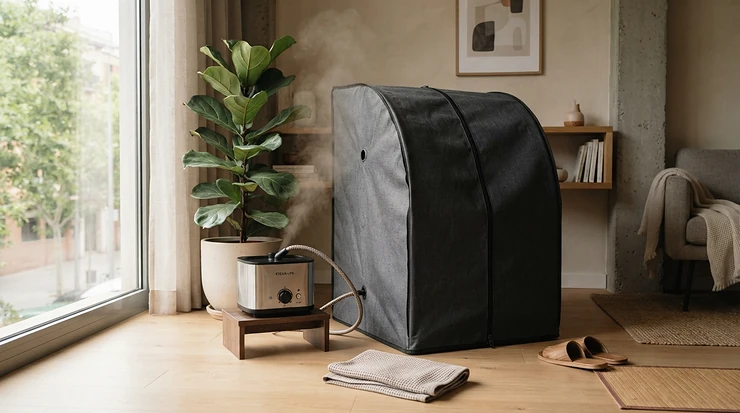
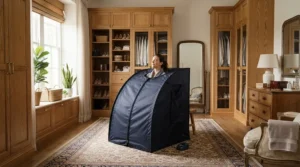
A sauna tent for home use is a foldable, fabric-walled enclosure that holds heat around one seated adult. It runs on infrared panels or a steam generator and plugs into an ordinary wall socket. It assembles in minutes, folds into a cupboard afterwards, and costs a sliver of what a built-in cabin would.
Think of it as a pop-up tent that went to finishing school. You sit on a folding chair, zip yourself in, and let the heat get on with it. In a country of small flats and soggy Octobers, the pitch is hard to resist: sauna-style warmth without the joiner, the planning headache or the permanent footprint.
The twist is the heat source. An infrared sauna tent warms you mainly by radiation rather than by heating the air around you, while steam tents fill the enclosure with humid heat. Wikipedia also dismisses the headline-grabbing claims about curing serious illnesses as pseudoscience. That’s a healthy dose of scepticism to carry into any shopping basket.
This guide draws on real specifications, retailer listings and the genuine themes in published reviews. I haven’t tested any of these tents myself, and I won’t pretend otherwise. Prices appear as ranges, based on research in October 2026. One UK warning up front: some tents are US imports with 110V electronics, and a UK reviewer on a reseller listing reported exactly that headache. Insist on 230V and a UK plug.
Quick Comparison: Sauna Tent for Home Use at a Glance
Here’s the whole field on one screen before we go deep.
| Product | Heat type | Stated temperature | Seating | Best For |
|---|---|---|---|---|
| SereneLife Full Size Infrared Home Spa | Far infrared | Around 60°C | Folding chair and foot pad | Budget first-timers |
| COSTWAY Portable Far Infrared Sauna Box | Far infrared (3 carbon heaters) | Up to 60°C | Folding chair (per listing) | Tight storage |
| WILLOWYBE Portable Infrared Sauna | Far infrared (6 plates, 1,250W) | Not verified | Foot pad; check chair | Even heat coverage |
| COSVALVE Portable Infrared Sauna | Far infrared (4 panels) | Not verified | Heated foot pad | Mid-budget infrared |
| COSTWAY Full Body Steam Sauna Tent | Steam (3L generator) | 35-63°C | Folding chair | Steam fans on a budget |
| Sharper Image Portable Steam Sauna Tent & Red Light | Steam plus red and near-infrared light | Adjustable | Folding chair and foot pad | Brand-backed warranty |
| WestWood Portable Sauna Tent Set | Steam (1,200W, 3L) | 99-minute timer | Folding chair | Remote-controlled steam |
Reading across the table, the SereneLife Full Size Infrared Home Spa is the cheapest way to try infrared heat. The COSTWAY Full Body Steam Sauna Tent has the most clearly documented temperature range for steam fans. The WILLOWYBE Portable Infrared Sauna pulls ahead on heater count, so it suits anyone who wants broader coverage and will pay for it. Where a cell says “not verified”, I couldn’t find a trustworthy figure, so check the live listing before buying.
💬 Just one click — help others make better buying decisions too!😊
Top 7 Sauna Tent for Home Use Picks: Expert Analysis
1. SereneLife Full Size Infrared Home Spa — cheapest way into infrared
The headline is simple. This is the lowest-cost route into far-infrared heat that I found, and it comes with the largest pile of public reviews.
It’s a one-person, pop-up style tent with a heated foot pad and folding chair. Reviewers describe it as light (around 20 lb) and quick to fold into a car boot. The open-top design keeps your head and arms outside the heat, which makes the first session less claustrophobic. Heat tops out at roughly 60°C (140°F). Expect gentle, sustained warmth rather than the scorch of a Finnish cabin.
Based on the spec comparison, this is a try-before-you-commit tent. It’s far infrared only, with standard EMF rather than low-EMF shielding, and one review site calls the build flimsy next to hardwood cabins. That’s fair at this price, but it matters if you plan daily use for years.
Aggregated review themes are consistent. Reviewers praise the easy setup and value, but complain about uneven heating, an uncomfortable chair and a foot pad that runs very hot. Tall users, particularly those over six feet, say it fits but only just. The amazon.co.uk listing showed a mid-four-star average across a few hundred ratings at the time of research. UK buyers should confirm plug and voltage, because US-spec units have turned up on UK reseller listings.
Pros:
- ✅ Low entry price for infrared heat
- ✅ Light and quick to fold away
- ✅ Chair and foot pad included
Cons:
- ❌ Foot pad can run uncomfortably hot
- ❌ Basic build with standard EMF
Price range: roughly £190-£250 at the time of research; check current price. Verdict: excellent value for experimenting, modest value as a ten-year appliance.
2. COSTWAY Portable Far Infrared Sauna Box — folds flat in minutes
What stands out is how small it gets. The detachable stainless steel frame folds flat in minutes, a real advantage if the cupboard under the stairs is your only spare space.
Three carbon heaters take the tent to around 60°C, wrapped in a three-layer insulated cover. Carbon heaters warm up quickly, but treat the listing’s fast-heating claims as describing the panels, not the whole tent. Allow roughly ten minutes for the air and fabric to catch up, as comparable tents state. A stainless frame is the right material here, because it tends to shrug off heat and damp better than painted steel.
Three heaters is about the minimum sensible layout, typically covering the sides and back. The trade-off against the six-plate WILLOWYBE Portable Infrared Sauna is coverage, so expect less even warmth around the thighs and shoulders. For a single sitter who wants a compact, tidy tent for a flat, that’s an acceptable compromise.
I couldn’t verify independent review text for this exact model, so I won’t characterise buyer sentiment. When you read the amazon.co.uk reviews, filter for comments on zips, the chair and long-term heater reliability, which are the usual failure points in this category.
Pros:
- ✅ Frame folds flat for easy storage
- ✅ Three-layer insulated cover
- ✅ Stainless steel frame resists heat and damp
Cons:
- ❌ Only three carbon heaters
- ❌ Independent review evidence hard to verify
Price range: expect the same broad £150-£300 band as comparable infrared tents; check current price. Verdict: a sensible mid-budget pick if storage is your main constraint.
3. WILLOWYBE Portable Infrared Sauna — six heating plates for broader coverage
Six heating plates is the headline, and it’s the highest heater count among the infrared tents here.
The listing pairs those plates with a 1,250-watt heating element, a foot heating pad and a warm LED light. At 230V that’s roughly 5.4 amps, comfortably within a single 13-amp socket provided nothing heavy shares it. More plates means radiant heat reaches your back, thighs and calves instead of concentrating on a couple of hot spots.
On paper this is the best coverage-per-pound for anyone who found cheaper tents patchy. The warm LED light is a small but welcome touch for winding down. The brand also sells steam tents and wood-stove tent sets, which suggests a specialist rather than a one-product seller. That’s a modest trust signal, not proof of quality.
I couldn’t find enough verifiable review text for this exact listing to summarise sentiment honestly. Read the most recent three-star reviews on amazon.co.uk first. They tend to expose build and customer-service issues faster than five-star praise or one-star rants.
Pros:
- ✅ Six plates for broader heat coverage
- ✅ Strong 1,250W heating element
- ✅ Warm LED light adds ambience
Cons:
- ❌ Little independent review evidence found
- ❌ Maximum temperature not verified
Price range: I couldn’t confirm a stable price, so check the live listing and benchmark it against the £190-£250 SereneLife Full Size Infrared Home Spa. Verdict: worth a premium only if the price gap is modest and the warranty terms are clear.
4. COSVALVE Portable Infrared Sauna — four panels, heated foot pad
The pitch is the middle path: four heating panels and a heated foot pad in a one-person format. It’s aimed at people who want more than a basic tent without paying for six plates.
Four-panel layouts in this category commonly put heaters at both sides, the back and the foot pad. That’s a sensible allocation of heat where you actually sit. Single-person tents like this usually occupy roughly 80-95cm square, so they suit spare bedrooms and bathrooms better than hallways.
What the listing doesn’t tell you matters as much as what it does. Before buying, check the wattage, the maximum temperature, the dimensions against your seated height, and whether the plug is UK-fitted. If those numbers are published, it’s a fair middle-tier option. If they’re vague, move on.
Heated foot pads are the most commonly reported trouble spot across infrared tents, since SereneLife Full Size Infrared Home Spa reviewers flagged it too. Keep your socks on for the first few sessions. Independent review text for this model was too thin for me to summarise honestly, so rely on the return window rather than the star rating alone.
Pros:
- ✅ Four-panel layout balances cost and coverage
- ✅ Heated foot pad included
- ✅ Single-user footprint suits small rooms
Cons:
- ❌ Specifications less transparent than rivals
- ❌ Limited independent review evidence
Price range: check current price; expect it between the budget and six-plate options. Verdict: decent if the spec sheet checks out.
5. COSTWAY Full Body Steam Sauna Tent — nine temperature steps, 35-63°C
Control is the standout. You get nine temperature steps, timers up to 90 minutes, and adjustment from a remote or a panel on the generator.
A 3-litre steam generator with a stainless-steel inner pot feeds a four-layer waterproof tent with zippered windows and a door. Safety features include a tempered-glass lid, overheat protection and a no-dry-heating cut-out. The bundle adds a folding chair, herbal box, wooden foot massager and storage bag. Steam at 63°C feels far more intense than dry heat at the same temperature, because humid air transfers heat to skin efficiently and sweat can’t evaporate easily.
The 35-63°C range gives beginners a gentle ramp. The practical catch is upkeep. Steam means condensation inside the tent and limescale in the pot, which matters in UK hard-water postcodes. Use filtered or descaled water if the manual allows, and treat the herbal box as optional garnish, not a licence to tip things into the generator.
Retail listings flag it as a top seller, but I couldn’t verify independent review text, so I won’t paraphrase buyer sentiment.
Pros:
- ✅ Wide 35-63°C range in nine steps
- ✅ Several overheat and dry-boil protections
- ✅ Chair and accessories included
Cons:
- ❌ Condensation and limescale upkeep
- ❌ Steam can feel oppressive for some
Price range: listings sat around £110-£130 at the time of research; check current price. Verdict: strong value for a steam fan.

6. Sharper Image Portable Steam Sauna Tent & Red Light — brand-backed steam plus light
The hook is a recognisable brand with red and near-infrared light on top of steam.
It measures roughly 1.67 metres tall and 85cm square and weighs 7.12kg. That’s light enough to carry upstairs and small enough to sit beside a bed. The kit includes a steam generator, folding chair, foot pad, water pitcher, diffuser and power adapter. It also has adjustable temperature, an auto shut-off timer and a one-year manufacturer’s guarantee.
The guarantee and brand support are the real differentiators among low-cost kits, because warranty claims on anonymous imports are famously painful. The light function deserves scepticism. I haven’t found independent evidence that it adds measurable benefit inside a tent, so treat it as a bonus rather than a reason to pay extra. Check where the head opening sits against your seated height too.
I couldn’t verify independent review text. The listing I found was at Currys rather than Amazon, so confirm Amazon availability, the seller and the warranty terms before relying on any guarantee.
Pros:
- ✅ Brand-backed one-year guarantee
- ✅ Light at 7.12kg and compact
- ✅ Includes foot pad, chair and diffuser
Cons:
- ❌ Red-light benefits remain unproven
- ❌ Amazon availability varies by seller
Price range: check current price; by feature set it sits in the mid-range. Verdict: reasonable if warranty peace of mind matters to you.
7. WestWood Portable Sauna Tent Set — remote-controlled 1,200W steam
Convenience wins here: a remote control, a 99-minute timer and a 1,200W steam generator in one kit.
The 3.0-litre generator shuts itself off if the water boils dry. The tent adds a transparent window, a side pocket for a phone or remote, and a towel hook. The kit also includes a floor mat, stainless steel frame and foldable chair. At 230V, 1,200W draws about 5.2 amps. That’s fine on a normal wall socket but not on a daisy-chained extension.
A transparent window sounds trivial, but it eases the boxed-in feeling. The hook and pocket are the small details that make sessions less fiddly. The 99-minute timer is a ceiling, not a target, since guidance for saunas and steam rooms generally says 15-20 minutes at most. Set your own alarm. In near-identical territory to other budget steam kits, the remote and window are the tie-breakers against the COSTWAY Full Body Steam Sauna Tent.
I found no verifiable review text. The listing was marketplace-sold by a UK seller, so check amazon.co.uk for current sellers and the returns policy.
Pros:
- ✅ Remote control with long timer range
- ✅ Auto shut-off if the pot boils dry
- ✅ Window, pocket and towel hook included
Cons:
- ❌ 99-minute timer invites overlong sessions
- ❌ Independent review evidence not verified
Price range: comparable budget steam kits sit around £100-£150; check current price. Verdict: solid value if you want steam with remote control.
Top 7 Side by Side
| Product | Price band | Heat type | Review evidence | Best For |
|---|---|---|---|---|
| SereneLife Full Size Infrared Home Spa | £190-£250 | Infrared | Several hundred UK ratings | First-time infrared buyers |
| COSTWAY Portable Far Infrared Sauna Box | Check price | Infrared | Not verified | Small-space storage |
| WILLOWYBE Portable Infrared Sauna | Check price | Infrared | Not verified | Wider heat coverage |
| COSVALVE Portable Infrared Sauna | Check price | Infrared | Not verified | Mid-budget infrared |
| COSTWAY Full Body Steam Sauna Tent | £110-£130 | Steam | Not verified | Steam on a budget |
| Sharper Image Portable Steam Sauna Tent & Red Light | Check price | Steam plus light | Not verified | Warranty-minded buyers |
| WestWood Portable Sauna Tent Set | £100-£150 | Steam | Not verified | Remote-control convenience |
The honest pattern here is that only the SereneLife Full Size Infrared Home Spa has deep public review evidence. The rest need your own due diligence on the live listing. If you value documented track record above all, that tilts towards it. If you value coverage or steam, the spec-led picks earn their place despite thinner data.
Setup and First 30 Days: Using a Sauna Tent for Home Use Properly
Unboxing is the easy bit. The first month decides whether your sauna tent for home use becomes a habit or an expensive coat-hanger.
Choose the Spot
Pick a hard, level, wipe-clean floor, such as a tiled bathroom or a spare room with a waterproof mat. Keep curtains, bedding and shelves well away. Plug straight into a wall socket and keep fabric clear of the generator or panels.
Weeks One to Four
- Week one: run the empty tent on the lowest setting for 10-15 minutes with a window open, because new fabric and foot pads can smell. Then try 10-minute sessions. A cheap room thermometer inside, at seated chest height, shows what the dial actually delivers.
- Weeks two and three: build towards 15-20 minutes at most. Drink water before and after, skip alcohol, put a towel under your thighs, and stand up slowly. Use a phone timer instead of trusting the maximum on the tent.
- Week four: settle into two to four sessions a week. Wipe the interior, leave the zips open so the fabric dries, and descale a steam pot as the manual directs.
Mistakes to Skip
The classic errors are overfilling the steam pot, sitting too close to panels, folding the tent while damp, and cranking everything to maximum on day one. Mould smells are far easier to prevent than cure.
Real-World Scenarios: Matching a Sauna Tent for Home Use to Your Life
The Renter in a One-Bed Flat
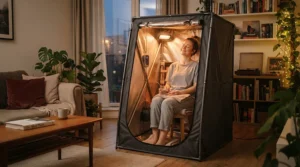
Budget is around £200, the bathroom is the only hard floor, and sessions happen two or three times a week. Dry infrared suits this life: no condensation on the walls, and the tent folds into a wardrobe. The SereneLife Full Size Infrared Home Spa or the COSTWAY Portable Far Infrared Sauna Box fits the brief.
The Weekend Runner With a Spare Room
Budget stretches further, sessions run three or four times a week, and patchy heat will irritate quickly. Broader coverage justifies paying more here, so the WILLOWYBE Portable Infrared Sauna or COSVALVE Portable Infrared Sauna deserves a look. Check the warranty terms before you commit, because frequent use finds weak zips and heaters fast.
The Steam-Loving Household
Two adults share one tent, with a tiled bathroom, a £100-£150 budget and two sessions a week. Humid heat is the draw, and the COSTWAY Full Body Steam Sauna Tent or WestWood Portable Sauna Tent Set suits it. Add a waterproof mat and wipe the walls afterwards. Anyone under 18, pregnant, or living with heart or blood pressure conditions should speak to a doctor first.
✨ Ready to Warm Up Your Wellness Routine?
🔍 Take your sauna tent for home use shortlist to the next level. Click any bold product name to check current pricing and availability on amazon.co.uk, then compare the warranty and returns terms. These tools will help you build a calm, repeatable relaxation habit at home!
How to Choose a Sauna Tent for Home Use: 7 Steps
To choose a sauna tent for home use, pick infrared or steam first, confirm 230V and a UK plug, then match size, materials, zips and seating to your body and room.
- Decide on heat type. Dry infrared panels suit people who dislike humidity; steam suits those who want that enveloping, damp warmth.
- Confirm 230V and a UK plug. This single check prevents the most expensive mistake on the list.
- Measure your seated height and the footprint. Compare against the listed dimensions, since tall users report tents fitting only just.
- Inspect tent material and heat retention. Look for insulated layers, a wipe-clean interior and a frame that handles heat and damp.
- Study the zip and ventilation design. Double-sided zips and windows let you manage temperature and exit quickly.
- Think about chair vs floor seating. Check the chair’s weight rating and whether you can swap in your own stool.
- Check the warranty, returns window and total budget. Remember running costs and upkeep, not just the sticker price.
Infrared Sauna Tent vs Steam Tent: Which Heat Suits You?
An infrared sauna tent uses panels that radiate heat directly onto your body, so the air inside can stay comparatively cool while you still sweat. Steam tents do the opposite, saturating the enclosure with moisture. Commonly quoted figures put infrared cabins at roughly 40-60°C inside, against 70-90°C for traditional saunas, which matches the 60°C ceilings on these tents.
In practice, the difference shows up in three places. Comfort: dry heat is easier to breathe for some people, while steam feels heavier and more intense at the same temperature. Upkeep: infrared needs little beyond wiping down, whereas steam brings condensation and limescale. Warm-up: both take roughly ten minutes to feel properly warm, though steam can feel hot sooner.
Health expectations deserve calm perspective. The strongest-sounding sauna research comes from Finland, where large observational studies link frequent traditional sauna bathing with lower cardiovascular risk. This review of sauna bathing research notes that further randomised studies are needed to establish the mechanism. Nothing in it tests a fabric tent, so enjoy yours for relaxation and warmth rather than as medicine.
My steer is simple. If you want low maintenance and dry heat, buy an infrared sauna tent. If you want a damp, spa-like session and don’t mind descaling, choose steam.
Tent Material and Heat Retention: What the Layers Really Do
Tent material and heat retention decide how much electricity you waste and how quickly you get comfortable. Layer counts on listings are marketing shorthand, but they hint at a common build: a waterproof inner skin, a cotton or PP-cotton insulating core, and a polyester or satin outer.
The COSTWAY Portable Far Infrared Sauna Box advertises three insulated layers, while the COSTWAY Full Body Steam Sauna Tent uses four waterproof layers. Some competitors claim five, but extra layers don’t automatically mean better performance. Seams, zip gaps and the neck opening usually leak more heat than the fabric itself.
For contrast, the wood-fired Bast Sauna tent uses a three-layer fire- and waterproof fabric with cotton insulation between two Oxford layers. That’s built for stove heat above 90°C and rain, which tells you how much more demanding a fire-heated tent is than a 60°C plug-in one.
Practical tests help. After ten minutes of use, hold your hand near the seams and zips: noticeably cooler air or escaping steam signals leaks. Prefer an interior you can wipe clean, because sweat and steam soak into untreated fabric. Better tent material and heat retention also means shorter warm-ups, which lowers both running costs and the temptation to crank the dial.
Zip and Ventilation Design: Comfort, Safety and Condensation
Zip and ventilation design is the unglamorous feature that separates a pleasant session from a sweaty struggle. Look for double-sided zips, which let you open the door from the top or bottom, and for hand openings that let you read or hold a phone without letting heat escape.
The WestWood Portable Sauna Tent Set adds a transparent window, which reduces the boxed-in feeling. The COSTWAY Full Body Steam Sauna Tent has zippered windows and a door specifically for airflow. Even wood-fired tent makers lean on ventilation hatches to regulate temperature, because opening a vent is the simplest way to cool down without leaving.
Safety matters here too. You should always be able to open the zip from the inside with one hand, quickly, even when dizzy. Check that zips glide without snagging fabric, because a stuck zip in a hot enclosure is stressful. Keep the doorway clear of cables and the generator hose.
For condensation, steam tents benefit from cracking a zip slightly near the end of a session, then leaving everything open afterwards so the fabric dries. Dry infrared tents need less ventilation but still benefit from an open zip when you finish. Good zip and ventilation design lets you fine-tune temperature without touching the controller.
Chair vs Floor Seating in a Sauna Tent: Which Works Better?
The chair vs floor seating debate sounds trivial until you’re ten minutes into a session and your lower back disagrees with the manufacturer’s choice. Every kit here ships with a folding chair, but quality varies. Listed weight ratings range from around 90kg to roughly 150kg across the kits I found, and reviewers of some tents complain the chair is uncomfortable, particularly for bigger users.
Chairs offer a clear advantage: they lift you off the floor, put your head near the opening and keep your thighs away from a cold or damp floor. The downside is that cheap folding frames flex and creak, and a rigid wooden or plastic stool can feel sturdier. Swapping in your own stool is a simple fix, provided it fits the tent.
Floor seating, perhaps on a folded towel or mat, drops you lower inside the enclosure. Hot air and steam tend to rise, so floor-sitters may feel less heat on the upper body in steam tents. It also makes rising harder, which matters if you feel light-headed afterwards.
My steer: sit, don’t lie down, and don’t doze off. Pick a stable seat, put a towel underneath, and test both options during a short first session. In the end, chair vs floor seating comes down to comfort, mobility and whether your tent allows a stool swap.
Sauna Tent vs Traditional Alternatives: Where Each One Wins
| Option | Heat | Setup | Space | Best For |
|---|---|---|---|---|
| Sauna tent for home use (infrared or steam) | Around 60°C typical | Minutes, plug in | About a metre square | Flats and renters |
| Rigid infrared cabin | Comparable infrared heat | Assembly, permanent spot | Dedicated room space | Frequent use at home |
| Bast Sauna tent (wood-fired) | Above 90°C | Quick pop-up plus stove | Garden-sized | Garden sauna fans |
| Leisure-centre sauna | Traditional, hotter | None | None at home | Occasional users |
Looking at the table, a sauna tent for home use wins on flexibility, speed and cost of entry. Its limits are heat level and durability. The wood-fired Bast Sauna tent delivers authentic temperatures and sits 4-6 people, but UK orders carry VAT and customs handling on arrival and need a garden, a stove and fire-safety care. For daily indoor use in a flat, a plug-in tent is the pragmatic compromise.
Safety, Regulations and Electrical Checks for UK Homes
Start with the electrics. Buy only 230V kits with a UK plug, and look for UKCA or CE marking on the product and manual. If a listing mentions 110V, walk away, because adaptors don’t fix the mismatch safely.
Plug the tent straight into a wall socket. Electrical Safety First advises against overloading sockets and against daisy-chaining extension leads, and heaters and steamers draw several amps continuously. A 1,200-1,250W kit uses roughly 5 amps, fine on a wall socket, but a poor candidate for a multi-way lead.
Steam generators bring scald risks. Never refill a hot generator, keep hoses straight, and don’t pour anything into the pot unless the manual allows it. Replace damaged cables immediately.
On health, most saunas and steam rooms advise sessions of around 15-20 minutes at most, with water before and after and no alcohol. Pregnant people, children, and anyone with heart or blood pressure conditions should speak to a doctor before use. Don’t fall asleep inside, and have someone else in the house when you can. Treat timers on these tents as maximums, not recommendations.
Long-Term Cost & Maintenance: Is a Sauna Tent for Home Use Worth It?
The sticker price is only half the story. A 1,200-1,250W tent running a 30-minute session uses at most about 0.6kWh, and thermostats cycle heaters off, so the real figure is usually lower. At an illustrative 25p per kWh (check your own tariff), that’s roughly 15p per session.
| Tier | Examples | Price band | Cost per session at 150 uses a year | Verdict |
|---|---|---|---|---|
| Budget steam | COSTWAY Full Body Steam Sauna Tent, WestWood Portable Sauna Tent Set | £100-£150 | About £0.65-£1.00 plus power | Cheapest to own |
| Budget infrared | SereneLife Full Size Infrared Home Spa | £190-£250 | About £1.30-£1.70 plus power | Good for trying infrared |
| Mid-range infrared | WILLOWYBE Portable Infrared Sauna, COSVALVE Portable Infrared Sauna, COSTWAY Portable Far Infrared Sauna Box | Check price | Depends on live price | Worth it if used often |
Per-session costs fall quickly with use, so a tent used three times a week beats one that gathers dust. Maintenance keeps those numbers honest. Wipe the interior after each session, dry the fabric fully before folding, and descale steam generators in hard-water areas. Inspect foot-pad cables and chair joints regularly, and check warranty length, since the Sharper Image Portable Steam Sauna Tent & Red Light lists one year. Cheaper tents may last less, so buy with a realistic horizon of a few years.
FAQ
❓ How much does a sauna tent for home use cost in the UK?
❓ Is an infrared sauna tent better than a steam sauna tent?
❓ Can I use a sauna tent for home use in a flat?
❓ How long should I stay in a sauna tent?
❓ Does a sauna tent need special electrics?
Conclusion
A sauna tent for home use is the lowest-friction way to bring sauna-style warmth into a British home, and 2026’s market gives you a genuine spread of choices. The key is matching heat type, build quality and honest expectations to your life.
If you want the cheapest, best-documented entry to infrared, the SereneLife Full Size Infrared Home Spa is the logical starting point. If compact storage rules your decision, the COSTWAY Portable Far Infrared Sauna Box deserves a look. For broader coverage, check the WILLOWYBE Portable Infrared Sauna and COSVALVE Portable Infrared Sauna listings carefully. For humid heat on a budget, the COSTWAY Full Body Steam Sauna Tent and WestWood Portable Sauna Tent Set lead, while the Sharper Image Portable Steam Sauna Tent & Red Light appeals to warranty-minded buyers.
Whatever you choose, confirm 230V and a UK plug, keep sessions short, and treat the tent as a relaxation tool rather than medicine. Check tent material and heat retention, zip and ventilation design, and chair vs floor seating before you commit. The best sauna tent for home use is the one you’ll use twice a week for years.
✨ Ready to Find Your Perfect Tent?
🔍 Click on any bold product name to check current pricing and availability on amazon.co.uk, compare warranty and returns terms, and choose the sauna tent for home use that fits your space and routine. Your calmest evenings are one zip away!
Recommended for You
- Portable Sauna For Weight Loss: 7 Honest Picks For UK Homes (2026)
- Portable Saunas Under £150: 7 Best Honest Picks (2026)
- Portable Sauna For Home Use: 7 Best Picks For UK Flats (2026)
Disclaimer: This article contains affiliate links. As an Amazon Associate, I earn from qualifying purchases. If you purchase products through these links, we may earn a small commission at no additional cost to you.
✨ Found this helpful? Share it with your friends! 💬🤗
