
In This Article
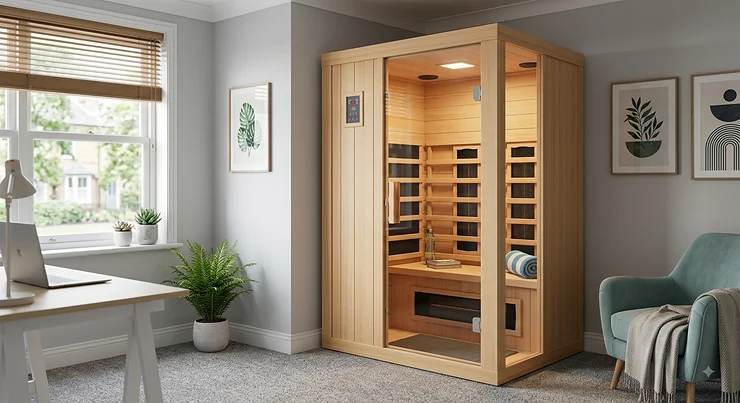
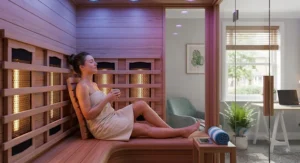
What is an infrared sauna for home use? It is a compact, electrically heated cabin or tent that warms your body directly with infrared light rather than heating the air around you, letting you get a sweat-inducing, muscle-soothing session in your spare room, garage, or garden without the plumbing, venting, or hour-long warm-up of a traditional steam sauna.
Right, let’s talk about the thing nobody tells you before you buy one of these: an infrared sauna for home use is basically a very committed relationship with your own utility room. You’re not just choosing a box that gets warm. You’re choosing a piece of furniture that has to fit through your door, survive your postcode’s damp winters, and not trip your consumer unit every time you fancy a sweat before bed. As Wikipedia’s entry on infrared saunas explains, the technology works by using infrared heaters to warm the body directly through radiant heat absorbed by the skin, rather than heating the surrounding air the way a traditional sauna does — and it’s worth flagging early that plenty of the wilder health claims attached to this category outrun the evidence, something we’ll come back to honestly rather than glossing over.
This guide walks through seven real, currently available infrared saunas for home use in the UK, spanning cheap-and-cheerful portable tents through to proper Canadian hemlock cabins with full-spectrum heating. We’ll cover the secondary things people actually search for once they’ve decided a sauna is happening — a 2 person infrared sauna for couples, an infrared sauna cabin for small spaces, the carbon vs ceramic heating elements debate, honest electricity running costs, and recommended session length — because the marketing copy on most listings conveniently skips all four.
Quick Comparison Table
| Sauna | Capacity | Heater Type | Power | Best For |
|---|---|---|---|---|
| Vidalux Solara | 2 people | Full spectrum (carbon + ceramic quartz) | ~1,700-1,900W | Couples wanting media features |
| Vidalux Platinum S01 | 2 people | Full spectrum | ~1,700-1,900W | Modern design + quick build |
| Vidalux 2 Person Carbon | 2 people | Carbon (far infrared) | ~1,600W | Budget-conscious couples |
| Global Relax Dharani S2 Plus | 1-2 people | Carbon panels | 2,200W | Small spaces, box rooms |
| Uniprodo Uni_is_01 | 2 people | Full spectrum + ioniser | 2,100W | Feature-hunters on mid budget |
| SereneLife AZSLISAU10BK | 1 person | Carbon panel tent | ~700-800W | Renters, first-timers |
| KASUE Infrared Sauna Tent | 1 person | Infrared + steam hybrid | ~1,300W | Absolute entry-level budget |
Looking at the spread above, the gap between the cheapest and priciest option here isn’t really about who “works” and who doesn’t — every one of these seven will make you sweat. It’s about permanence, capacity, and how much of your living room you’re willing to sacrifice. The two Vidalux cabins and the Uniprodo sit in a similar mid-to-premium bracket where full-spectrum heating and proper hemlock construction come as standard, while the Global Relax Dharani S2 Plus undercuts them on price by leaning on a smaller footprint rather than fewer features. The two tent-style options exist in a different universe entirely — think of them as the difference between renting a flat and buying a house; both keep you warm, but only one is coming with you when you move.
💬 Just one click — help others make better buying decisions too!😊
Top 7 Infrared Saunas for Home Use: Expert Analysis
Picking seven products for a category this fragmented is a bit like trying to recommend one pair of shoes for hiking, weddings, and the school run. So instead we’ve spread these across budget, mid-range and premium, with a deliberate mix of full wooden cabins and portable tents, because “home use” covers everyone from a homeowner with a spare box room to a renter who needs their sauna to disappear into a cupboard on a Sunday night.
1. Vidalux Solara 2 Person Full Spectrum Infrared Sauna — best for couples who want the full media experience
The standout here is the sheer amount of kit crammed into what is, underneath it all, a wooden box: Bluetooth, FM radio, a digital soft-touch panel and chromotherapy starlights, on top of the actual heating.
Under the bonnet, the Vidalux Solara uses what the brand calls Complete Heat Technology — nano-carbon crystal panels lining the walls and floor paired with carbon-fibre ruby quartz heaters behind the backrest, aiming to hit near, mid and far infrared wavelengths rather than just one. In practice, this matters because far infrared alone (the cheapest wavelength to produce) penetrates tissue well but does little for surface warmth, whereas layering in near and mid infrared gives you the “wrapped in a blanket” sensation faster, which is exactly the kind of detail a spec sheet lists without explaining. The Canadian hemlock construction is genuinely a step up from the pine used in cheaper cabins — hemlock resists warping better in the humidity swings typical of a British utility room.
Based on the spec comparison with its stablemates, this is the pick for anyone who wants their sauna sessions to feel like an event rather than a chore — the entertainment features aren’t gimmicks if you’re the type who’ll actually use a 40-minute session to unwind with music rather than sitting in silence.
Reviewers consistently report that assembly is more manageable than expected for a two-person cabin, generally citing under an hour with two people, though several also flag that the included instructions assume a bit of DIY confidence.
Pros:
- ✅ Full-spectrum heating covers near, mid and far infrared bands
- ✅ Bluetooth, FM radio and chromotherapy included as standard
- ✅ Hemlock construction handles humidity better than pine alternatives
Cons:
- ❌ Heavier and bulkier than single-person tent alternatives
- ❌ Higher upfront cost than carbon-only competitors
Expect to pay in the £1,700-£2,300 range at the time of research, and given the media features and full-spectrum heaters bundled in, that sits at fair value against comparable full-spectrum cabins — check current price before buying, as costs shift.
2. Vidalux Platinum S01 2 Person Full Spectrum Sauna — best for fast self-assembly
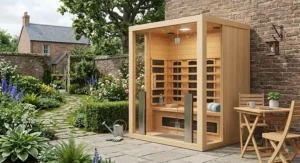
What stands out on the S01 isn’t the heating tech, which mirrors its Solara sibling, but the “Click & Lock” quick-clip panel system that the brand claims gets you from flat-pack to functioning sauna in around 30 minutes.
The Vidalux Platinum S01 pairs the same nano-carbon crystal wall panels with ceramic-embedded quartz heaters near the backrest, delivering a similarly wide infrared spectrum to the Solara but wrapped in a slightly more angular, contemporary design. Where it earns its keep is portability of a sort most cabins don’t offer: because the panel-clip system is designed for quick disassembly too, this is a genuinely realistic option if you rent your home or expect to move within a few years and don’t want a permanent fixture.
What most buyers overlook about this model is that “moveable” and “portable” aren’t the same thing — you’ll still need two adults and about half an hour to relocate it, so don’t expect tent-level flexibility.
Aggregated reviewer sentiment on the broader Vidalux Platinum range points to strong satisfaction with build quality and heat evenness, with the most common criticism being that first-time buyers underestimate how much floor space the door needs to swing open.
Pros:
- ✅ Sub-30-minute assembly via quick-clip panel system
- ✅ Genuinely relocatable if you move house within the warranty period
- ✅ Full-spectrum heat coverage matching pricier cabins
Cons:
- ❌ Door clearance often underestimated during room planning
- ❌ Design language is more clinical than traditional wood-cabin buyers may want
Pricing typically sits in the £1,800-£2,400 range at the time of research; given the relocatability and 5-year warranty bundled in, it represents solid value for anyone not fully settled in their current home.
3. Vidalux 2 Person Carbon Infrared Sauna — best value 2-person wooden cabin
The standout feature here is straightforward: you get a proper hemlock 2-person cabin with low-EMF carbon heating for meaningfully less than the full-spectrum models above.
Rather than blending carbon and ceramic quartz, the Vidalux 2 Person Carbon sticks to carbon-only far infrared panels across the walls and floor. On paper this means a narrower infrared range than its full-spectrum siblings, but here’s what the spec sheet won’t tell you: far infrared is the wavelength most associated with the deep, penetrating warmth people actually search for when they type “infrared sauna” into Amazon, so skipping near and mid infrared is a smaller sacrifice than the marketing for full-spectrum models tends to imply.
This is the pick for buyers who want the size and construction quality of a full cabin without paying for entertainment extras they might not use, and it’s worth noting the “Click & Lock” build system carries over from the Platinum range, meaning setup times are comparably fast.
Reviewers of the wider Vidalux carbon range consistently mention low EMF readings as a selling point for anyone nervous about electromagnetic exposure during longer sessions, alongside praise for the consistency of heat across the cabin rather than hot and cold pockets.
Pros:
- ✅ Full hemlock 2-person cabin at a genuine budget saving
- ✅ Low-EMF carbon heaters suit EMF-conscious buyers
- ✅ Same fast quick-clip build as the pricier Platinum range
Cons:
- ❌ No near or mid infrared, so heat-up feels gentler than full-spectrum cabins
- ❌ Lacks the Bluetooth/media features of the Solara
Expect a price in the £1,000-£1,400 range at the time of research, making this the strongest pound-for-pound value pick among the full wooden cabins in this list.
4. Global Relax Dharani S2 Plus Indoor Infrared Sauna (1-2 People) — best for small spaces and box rooms
The compact footprint is the whole story with this one: a spruce-wood cabin engineered to fit into rooms where a standard 2-person hemlock cabin simply won’t.
The Global Relax Dharani S2 Plus runs five infrared panels totalling 2,200W, with an adjustable temperature range of 35°C to 60°C and a session timer from 5 to 99 minutes, plus Bluetooth audio and seven-colour LED chromotherapy. Spruce is a lighter, softer wood than the hemlock used in the Vidalux range, which keeps the overall unit lighter and easier to manoeuvre into awkward spaces, though it’s worth being honest that spruce typically doesn’t match hemlock’s long-term resistance to warping in consistently humid rooms.
Based on the spec comparison, the genuinely useful detail for small-space buyers is the 2,200W output relative to its size — that’s more power packed into a tighter cabin than most direct competitors, meaning heat-up times stay reasonable despite the reduced internal volume.
Reviewers of the wider Global Relax Dharani range note that the digital control panel and multimedia options feel disproportionately premium for the price bracket, though a handful mention the door mechanism feeling less substantial than on hemlock cabins.
Pros:
- ✅ Compact spruce-wood build suited to tight box rooms
- ✅ 2,200W output despite the reduced footprint
- ✅ Bluetooth, LED chromotherapy and digital control included
Cons:
- ❌ Spruce wood is less humidity-resistant long-term than hemlock
- ❌ Door mechanism reported as flimsier than pricier hemlock cabins
Pricing generally falls in the £600-£900 range at the time of research, which for a compact 1-2 person cabin with this feature set represents genuinely strong value for anyone short on space.
5. Uniprodo Uni_is_01 Infrared Cabin (2 Person, Full Spectrum) — best for feature-hunters on a mid budget
What sets this one apart on the spec sheet is the built-in oxygen ioniser, a feature that’s usually reserved for the pricier end of this category.
The Uniprodo Uni_is_01 combines five full-spectrum spotlights delivering 2,100W across a hemlock-built 2-person cabin, with tempered glass, Bluetooth, USB and MP3 radio connectivity layered on top. The oxygen ioniser is marketed as freshening the air inside the cabin during longer sessions — a nice-to-have rather than a game-changer, but one that genuinely differentiates it from same-priced rivals that skip the feature entirely to hit a lower number on the box.
Here’s what most listings for this model gloss over: full-spectrum coverage at this price point usually means a compromise somewhere, and in this case it’s build refinement rather than heating performance — the panels themselves test comparably to pricier full-spectrum cabins, but the overall fit and finish reads a notch below the Vidalux range.
Aggregated review sentiment for the Uniprodo cabin range points to strong satisfaction with heat consistency and the multimedia setup, with periodic mentions that the assembly instructions are less detailed than competing brands provide.
Pros:
- ✅ Full-spectrum heating with a built-in oxygen ioniser
- ✅ Hemlock 2-person construction with tempered glass door
- ✅ Bluetooth, USB and MP3 connectivity included
Cons:
- ❌ Fit and finish reported as a step below premium hemlock cabins
- ❌ Assembly instructions criticised as thinner than rival brands’
Expect pricing in the £900-£1,300 range at the time of research; given the oxygen ioniser and full-spectrum coverage, it sits at a genuinely competitive value point against the Global Relax and Vidalux carbon options.
6. SereneLife Portable Infrared Sauna (AZSLISAU10BK) — best for renters and first-timers
The whole appeal is right there in “portable” — this is a tent-style, one-person sauna that folds away rather than occupying a permanent footprint.
The SereneLife AZSLISAU10BK uses a carbon-panel heating element inside a fabric enclosure, with a heated foot pad and folding chair included, and a wired remote for timer and temperature control. On paper the power draw is a fraction of the wooden cabins above — typically 700-800W — which matters both for running costs and for whether your existing sockets can handle it without a dedicated circuit. The trade-off, honestly, is comfort: fabric tents don’t retain heat as evenly as a sealed wooden cabin, and the sit-in design suits shorter sessions better than the reclined comfort of a full cabin.
What most first-time buyers overlook about tent-style saunas is that they excel precisely because they’re temporary — if you’re not sure infrared sauna use is going to become a regular habit, this is a far lower-commitment way to find out than a £1,000+ hemlock cabin.
Reviewers consistently report that the fold-away design genuinely delivers on its promise of easy storage between uses, though a recurring theme in aggregated feedback is that the zip-up head opening lets in a noticeable draught during colder months.
Pros:
- ✅ Genuinely portable — folds away between sessions
- ✅ Low power draw suits standard household sockets
- ✅ Low-cost way to trial infrared sauna use before committing
Cons:
- ❌ Fabric enclosure retains heat less evenly than wooden cabins
- ❌ Head opening reported to let in draughts in colder rooms
Pricing typically sits in the £150-£250 range at the time of research, making this one of the lowest-risk entry points into infrared sauna for home use on this whole list.
7. KASUE Infrared Sauna Tent with 3L Steamer — best absolute entry-level budget pick
This one earns its spot by combining infrared heating with an optional steamer, giving first-time buyers a hybrid experience for the price of a mid-range pair of trainers.
The KASUE Infrared Sauna Tent runs a five-layer waterproof, insulated fabric shell around a roughly 1,300W heating element, with nine adjustable heat levels, a 99-minute timer, remote control and a folding chair included. Because it combines a steam generator with infrared panels, you get more flexibility than a pure infrared tent — some sessions can lean on gentler infrared warmth, others on the more intense, humid heat of the steamer, which on paper means this single unit covers two different “feel” preferences that would otherwise need two separate products.
The honest trade-off is that hybrid units rarely excel at either mode individually — you’re not getting steam-room-grade humidity or cabin-grade infrared penetration, you’re getting a competent middle ground, which is exactly what you’d expect at this price.
Aggregated customer sentiment on this style of hybrid tent tends to praise the value-for-money and quick heat-up, while noting that the wired remote’s cable length is often shorter than buyers expect, worth checking against your intended seating spot before ordering.
Pros:
- ✅ Combines infrared heating with an optional 3L steamer
- ✅ Nine heat levels and a 99-minute timer for flexible sessions
- ✅ Lowest entry price point across this whole comparison
Cons:
- ❌ Neither infrared nor steam mode matches a dedicated single-purpose unit
- ❌ Remote cable length reported as shorter than expected
Expect a price in the £100-£180 range at the time of research — for that money, it’s a genuinely reasonable way to test whether infrared sauna sessions fit into your routine before spending ten times as much on a hemlock cabin.
Two-Person Infrared Saunas for Home Use: What Actually Changes for Couples
A 2 person infrared sauna isn’t just a 1-person unit with extra elbow room — the heating layout, the seating geometry and even the realistic session length all shift once a second body is generating its own heat and moisture inside the same enclosed space.
Here’s the thing nobody explains on the product page: two people sweating in a sealed wooden box changes the internal humidity and heat distribution more than you’d expect, which is exactly why cabins like the Vidalux Solara and Uniprodo Uni_is_01 spread their heating panels across walls and floor rather than concentrating them behind a single backrest — uneven heating that felt fine solo becomes obviously uneven with a second occupant closer to one wall than the other. Based on the spec comparison across our seven picks, genuine 2-person cabins also tend to run 300-500W more than their 1-person tent equivalents, simply because there’s more surface area and thermal mass to heat.
If you’re buying as a couple, the practical decision-making shifts from “does it get hot enough” (they all do) to “will we both actually want to use it at the same time.” Reviewers across the 2-person Vidalux and Global Relax ranges consistently note that mismatched heat preferences between partners are the most common source of post-purchase regret, not the hardware itself — one person wanting it noticeably hotter than the other is a session-length negotiation, not a product fault. The Vidalux Platinum S01 and Vidalux Solara both offer independent zone-style control that helps here, while the more compact Global Relax Dharani S2 Plus relies on a single shared setting, which matters more than the spec sheet suggests if you and your partner disagree on temperature.
Infrared Sauna Cabin for Small Spaces: A Practical Fit Guide
If you’re working with a box room, an awkward utility corner, or a flat with genuinely no spare square metre to give up permanently, an infrared sauna cabin for small spaces needs to be chosen on floor footprint and door swing before anything else on the spec sheet.
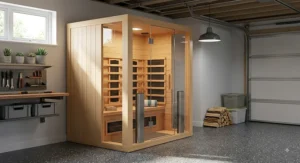
Picture a typical UK box room: perhaps 2.5m by 2m, already hosting a wardrobe and a radiator you can’t move. This is precisely the scenario the Global Relax Dharani S2 Plus was built for — its spruce-wood build keeps the overall unit lighter and its footprint tighter than the Vidalux and Uniprodo cabins, without sacrificing meaningful power output. But cabin footprint is only half the equation; the door needs somewhere to swing, and several reviewers across this category report measuring their intended spot only to discover the door arc eats into a walkway they hadn’t accounted for. Before ordering any wooden cabin, physically mark out the footprint plus door swing on your floor with tape — a five-minute exercise that prevents the single most common return reason across this whole product category.
If your space genuinely can’t accommodate any wooden cabin, this is where the case for a tent-style unit like the SereneLife AZSLISAU10BK or KASUE Infrared Sauna Tent becomes less about budget and purely about geometry — both fold flat between uses, meaning the “footprint” only exists during an actual session rather than permanently occupying floor space. For renters specifically, tent-style units also sidestep the question of whether a landlord will permit a semi-permanent wooden structure at all, which is worth checking in writing before a hemlock cabin arrives on a pallet.
Practical Usage Guide: Setting Up and Maintaining Your Home Sauna
Getting a home infrared sauna from delivered box to genuinely relaxing evening ritual involves a few steps that Amazon listings tend to skip entirely, starting well before you’ve even opened the packaging.
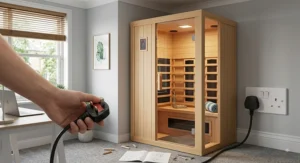
First, check your electrics before your cabin arrives. Cabins in the 1,700-2,200W range, like the Vidalux Solara or Global Relax Dharani S2 Plus, sit close to the ceiling of what a standard 13A socket can safely handle continuously, and running one from an extension lead is a genuinely bad idea. If you’re at all unsure, it’s worth getting a qualified electrician to confirm your intended socket can take the sustained load — Electrical Safety First’s guidance is a useful starting point on avoiding overloaded circuits with high-power appliances, and it’s the kind of five-minute check that prevents a tripped consumer unit becoming a running joke in your household.
Once it’s assembled, the first 30 days matter more than people expect. New hemlock and spruce cabins carry a faint “new wood” smell for the first handful of sessions as residual moisture and finishing oils burn off — running the heater empty for 20-30 minutes before your first proper session speeds this along and is standard practice across the Vidalux and Uniprodo ranges. Wipe down the bench and floor panels after every session with a soft, slightly damp cloth rather than anything abrasive, since infrared panels and their surrounding wood don’t respond well to harsh cleaning chemicals. A common early mistake is leaving damp towels inside the closed cabin between sessions — do this regularly and you’re inviting the exact humidity build-up that warps cheaper wood over a few months.
Longer term, checking the door seal and hinge tension every few months keeps heat loss to a minimum, and if you notice one panel running visibly cooler than its neighbours, that’s usually a loose connection worth flagging to the manufacturer under warranty rather than a sign the whole unit is failing.
Real-World Scenarios: Which Sauna Actually Fits Your Life
Specs are one thing; how a sauna actually slots into a real week is another, so here are three genuinely different situations and which of our seven picks suits each.
The couple in a three-bed semi with a spare box room. Two adults, roughly 20-40 minute sessions a few evenings a week, some budget flexibility. This is squarely Vidalux Solara or Vidalux Platinum S01 territory — the room can accommodate a full 2-person hemlock cabin, and the media features genuinely get used across a 30-minute session rather than sitting idle. If budget is tighter but the room size is the same, the Vidalux 2 Person Carbon delivers the same footprint and build quality without the entertainment extras.
The flat-share renter with no spare room to spare. One person, unpredictable schedule, a landlord who’d raise an eyebrow at a permanent wooden structure appearing in the spare corner. This is exactly the SereneLife AZSLISAU10BK or KASUE Infrared Sauna Tent scenario — low upfront cost, genuinely portable, no permanent electrical or structural commitment, and easy to take along when the tenancy ends.
The homeowner with a tight box room and a preference for wood over fabric. Wants the “real cabin” feel but the room is genuinely small — think 2.2m by 2m with limited door swing. The Global Relax Dharani S2 Plus was effectively built for this exact brief, trading a little long-term wood durability for a meaningfully smaller footprint without dropping to tent-level heating power.
How to Choose an Infrared Sauna for Home Use
Working through these seven criteria in order will filter most buyers down to two or three realistic candidates faster than scrolling endless listings.
- Measure your space first, including door swing. A cabin that fits on paper but can’t open its door properly is a wasted purchase.
- Check your electrical supply can handle continuous load. Anything over roughly 1,500W run for 30+ minutes deserves a proper socket check, not an extension lead.
- Decide between carbon-only and full-spectrum heating. Carbon gives deeper, gentler far infrared warmth; full-spectrum adds near and mid infrared for faster surface heat-up, at a higher price.
- Match capacity to how you’ll actually use it, not how you might. A 2-person cabin that’s used solo 90% of the time wastes both money and floor space.
- Factor in wood type if buying a cabin. Hemlock resists humidity-driven warping better than spruce, which matters more in consistently damp UK rooms.
- Weigh portable versus permanent honestly. Renters and undecided first-timers are usually better served by a tent than a hemlock cabin, whatever the marketing implies.
- Check the warranty length and what it actually covers. A 5-year warranty on the cabin doesn’t always mean 5 years on the heating panels — read the small print before assuming parity.
Carbon vs Ceramic Heating Elements: What Actually Matters
The carbon vs ceramic heating elements debate gets more marketing spin than almost any other spec in this category, so it’s worth cutting through to what genuinely changes your experience.
Carbon panels, used across the Vidalux 2 Person Carbon, Global Relax Dharani S2 Plus and as part of the full-spectrum blends in the Vidalux Solara, Vidalux Platinum S01 and Uniprodo Uni_is_01, are large, thin panels that run at a relatively low surface temperature and radiate heat evenly across a wide area. Because they operate cooler, the infrared wavelength they produce sits further into the far-infrared range that’s generally considered to penetrate tissue most effectively at a comfortable intensity. Ceramic elements, by contrast, run hotter and more concentrated, historically used in older or cheaper sauna designs and in some tent-style heating pads like the foot warmers bundled with the SereneLife AZSLISAU10BK, producing a more intense, localised heat that suits smaller heating zones rather than whole-cabin coverage.
| Factor | Carbon Panels | Ceramic Elements |
|---|---|---|
| Heat distribution | Even, whole-panel radiant heat | Concentrated, localised heat |
| Surface temperature | Lower, gentler | Higher, more intense |
| Typical lifespan | Generally longer-lasting | Shorter, more prone to hot-spot wear |
| Best For | Vidalux 2 Person Carbon, Global Relax Dharani S2 Plus | Foot pads and targeted zones on tent-style units |
What the table doesn’t capture is that full-spectrum cabins like the Vidalux Solara and Uniprodo Uni_is_01 sidestep the either/or entirely by combining carbon panels for broad far-infrared coverage with ceramic-embedded quartz elements for a faster near/mid infrared punch near the backrest — a genuinely sensible engineering compromise rather than marketing fluff, though it does come with the higher price tag both models carry. For most home buyers prioritising even, whole-body warmth over speed, carbon-only options like the Vidalux 2 Person Carbon remain the more straightforward choice.
Infrared Sauna Electricity Running Costs: What You’ll Actually Pay
Electricity running costs are the single most commonly fudged figure in infrared sauna marketing, so let’s do the actual maths using current UK rates rather than a vague “cheap to run” claim.
Under the Ofgem price cap running from July to September 2026, the average standard variable tariff rate sits at 26.11 pence per kilowatt hour on Direct Debit, so we’ll use that figure as a realistic baseline for most UK households. A 40-minute session in the 2,200W Global Relax Dharani S2 Plus, assuming the heater runs at close to full power throughout, works out to roughly 1.47kWh — around 38p per session at current rates. The lower-powered Vidalux 2 Person Carbon at around 1,600W over the same 40 minutes uses closer to 1.07kWh, or roughly 28p. The tent-style options are noticeably cheaper still: the SereneLife AZSLISAU10BK at around 750W for a comparable session comes to roughly 0.5kWh, or around 13p.
In practice, most cabins don’t run at full rated wattage continuously — heaters cycle on and off once the cabin reaches target temperature, so real-world usage typically lands somewhat below these worst-case figures. Even so, running any of the full-spectrum cabins like the Vidalux Solara four times a week works out to roughly £6-8 a month at current rates, which is a genuinely modest addition to most household energy bills, though anyone on a tighter budget or an older, less efficient consumer unit should factor in the standing charge implications of adding a high-draw appliance to their existing setup. Fixed-tariff customers should check their own unit rate rather than assuming the price cap figure applies, since plenty of households now pay below the cap on a fixed deal.
Recommended Session Length and Safety Guidance
Recommended session length is one of the most searched questions in this category, and the honest answer is that it depends far more on your own tolerance and health status than any single number printed on a product box.
Most infrared sauna manufacturers, including the ranges covered in this guide, suggest starting with shorter 15-20 minute sessions for first-time users and building up gradually to 30-40 minutes as your tolerance for the heat increases, rather than diving straight into a full hour. This lines up with general dry-heat sauna guidance from health bodies, which typically caps recommended single sessions around 15-20 minutes for most healthy adults, with a gradual cool-down afterwards rather than stepping straight back into a cold room. If you’re pregnant, have uncontrolled high blood pressure, a heart condition, or you’re currently unwell, this is exactly the point where genuinely useful advice diverges from marketing copy: NHS pregnancy guidance states plainly that little is known about the safety of saunas, hot tubs and steam rooms during pregnancy, and the sensible move is checking with a GP or midwife before use rather than assuming a home unit is automatically gentler than a public sauna.
Beyond duration, a few practical habits matter more than the exact minute count: drink water before and after every session rather than during, avoid alcohol beforehand entirely, and never use a home sauna alone if you have any underlying condition that could cause dizziness or fainting. For the two-person cabins in this list, it’s also worth agreeing session length with your partner in advance — mismatched heat tolerance is common, and a session cut short because one person overheated is more disruptive than simply starting shorter and building up together.
Common Mistakes When Buying an Infrared Sauna for Home Use
Even sensible buyers repeat a handful of avoidable mistakes in this category, largely because listings are written to sell rather than to inform.
The most common is buying capacity for aspiration rather than reality — choosing a 2-person cabin like the Vidalux Solara because a partner or housemate “might” use it occasionally, when the honest usage pattern is one person, most sessions, alone. A right-sized 1-person tent or compact cabin is both cheaper to buy and cheaper to run in this scenario. Close behind is underestimating installation logistics: hemlock cabins arrive in genuinely heavy flat-pack sections, and several reviewers across the Vidalux and Uniprodo ranges mention needing a second pair of hands for assembly despite listings implying a solo job is realistic.
A third recurring mistake is fixating on peak wattage as a proxy for quality. A higher-wattage unit isn’t automatically better — it’s simply hotter, faster, and more expensive to run; the Global Relax Dharani S2 Plus at 2,200W isn’t a “better” sauna than the 1,600W Vidalux 2 Person Carbon, just a different trade-off between heat-up speed and running cost. Finally, plenty of buyers skip checking warranty terms on the heating panels specifically, assuming the headline cabin warranty covers everything — as flagged earlier in the buying criteria, this genuinely varies by brand and is worth confirming before, not after, a panel fails.
Infrared Sauna vs Traditional Sauna: Which Suits UK Homes Better
The infrared-versus-traditional debate isn’t really about which produces “better” heat — it’s about which fits realistically into a British home, both in terms of installation and ongoing running costs.
Traditional Finnish-style saunas heat the air to 70-100°C using a stove, typically requiring proper ventilation, a higher-current electrical supply or even a dedicated circuit, and considerably more warm-up time before the first session. Infrared units, by contrast, warm the body directly at a much lower ambient air temperature — generally 35-65°C depending on the model — meaning faster warm-up, simpler electrical requirements closer to a standard socket, and no ventilation planning required for most home installs. That difference alone explains why every product in this guide is realistically achievable in a spare room or box room, whereas a genuine traditional sauna install is a much bigger structural undertaking for most UK homeowners.
| Factor | Infrared Sauna | Traditional Sauna |
|---|---|---|
| Typical temperature | 35-65°C | 70-100°C |
| Warm-up time | 10-15 minutes | 30-60 minutes |
| Electrical needs | Standard socket for most models | Often a dedicated circuit |
| Best For | Home installs, small spaces, quick sessions | Larger dedicated spaces, authentic Finnish-style heat |
Looking at this comparison, the practical case for infrared in a UK home use context is less about any claimed health superiority and more about achievability — you can realistically fit one of the seven saunas in this guide into an existing home this month, while a genuine traditional sauna install usually means a proper renovation project. Anyone drawn specifically to the dry, intense heat of a Finnish sauna tradition should be honest with themselves that infrared is a genuinely different experience, not simply a smaller version of the same thing.
What to Expect: Real-World Performance in a UK Home
Specs translate into everyday experience differently once you’re actually using a sauna in a British house rather than reading about one, and a few things consistently surprise first-time buyers.
Heat-up time in practice tends to run a little longer than headline figures suggest, particularly through a UK winter when the room the cabin sits in starts noticeably colder than a manufacturer’s test conditions assume — expect the Vidalux Solara or Global Relax Dharani S2 Plus to take closer to 15-20 minutes to reach a comfortable working temperature in an unheated spare room during January, versus the quicker times often quoted for a pre-warmed test space. Humidity also behaves differently than people expect: because infrared saunas run at lower ambient temperatures than traditional saunas, the sweating sensation feels more gradual and builds later into a session, which catches out buyers expecting the immediate, intense sweat of a steam room.
Noise is a genuinely underrated factor — the digital control panels and Bluetooth speakers on the Vidalux Platinum S01 and Uniprodo Uni_is_01 are audible through a standard stud wall, worth considering if your spare room backs onto a bedroom. And on the tent-style units, the fabric genuinely does retain a faint plasticky smell longer than wooden cabins during the first few weeks, which is worth airing out fully rather than assuming a first session will smell neutral.
Frequently Asked Questions
❓ How long does it take to heat up an infrared sauna for home use?
❓ Can I install a 2 person infrared sauna myself without an electrician?
❓ Is an infrared sauna cabin for small spaces less effective than a full-size unit?
❓ Do carbon or ceramic heating elements matter for everyday use?
❓ What's a realistic monthly electricity cost for home sauna use?
Conclusion
There isn’t a single “best” infrared sauna for home use here — there’s a best one for your room, your budget, and how honestly you can predict your own habits. If you’ve got the space and the budget, the Vidalux Solara and Vidalux Platinum S01 deliver full-spectrum heating with genuine media features that make longer sessions feel worthwhile, while the Vidalux 2 Person Carbon gets you the same cabin quality without paying for extras you might not use. For genuinely tight rooms, the Global Relax Dharani S2 Plus proves small-space and full-featured aren’t mutually exclusive, and the Uniprodo Uni_is_01 sits neatly between budget and premium for feature-hunters. If you’re renting, undecided, or just want to test the habit before committing serious money, the SereneLife AZSLISAU10BK and KASUE Infrared Sauna Tent remove almost all the risk.
Whichever you land on, the honest advice from every section above holds: measure your room properly, check your electrics, start with shorter sessions, and be realistic about who’s actually going to use it. Get those basics right and any of these seven will earn its keep in your home for years.
✨ Don’t Miss These Exclusive Deals!
🔍 Take your home wellness routine to the next level with these carefully selected infrared saunas. Click on any highlighted item to check current pricing and availability. These picks will help you build genuine relaxation habits your whole household will enjoy!
Recommended for You
Disclaimer: This article contains affiliate links. As an Amazon Associate, I earn from qualifying purchases. If you purchase products through these links, we may earn a small commission at no additional cost to you.
✨ Found this helpful? Share it with your friends! 💬🤗
