
In This Article
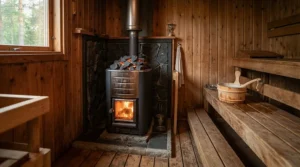
Wood burning saunas are heated by a real log fire instead of an electric element. The stove warms a bed of stones, the stones heat the air and flash ladled water into steam, and a flue carries the smoke away. No mains power is needed, so they suit gardens, allotments and off-grid plots.
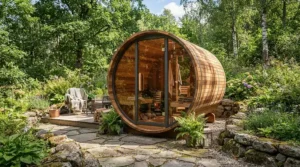
There’s something almost unfairly satisfying about the ritual. You split kindling, coax a fire into life, and forty-odd minutes later you’re sitting in dry, resinous heat while the garden goes dark and quiet around you. No thermostat. No app. Just a stove and the occasional pop of a log.
The wellness case is interesting too. A well-known Finnish study, covered by Harvard Health, tracked around 2,300 middle-aged men for roughly two decades. Those who bathed four to seven times a week fared markedly better on survival than once-a-week bathers. It’s observational, so it can’t prove the sauna did the work, but it explains why so many Britons are eyeing the bottom of the garden.
Here’s the catch: buying wood burning saunas in the UK isn’t a simple click-and-collect job. Stoves run from a few hundred pounds to well over £1,000. Barrels arrive flat-packed or fully built. Planning rules and smoke control areas can trip you up. Amazon UK listings for sauna stoves and heaters range from well under £1,000 to several thousand pounds, which tells you how wide this market is.
So here are seven real products across budget, mid-range and premium, from stoves to complete barrels. One honest note on method: this is desk research, not a hands-on test. Everything below comes from published specifications, retailer information and owner feedback left publicly, and I’ll flag anything I couldn’t verify.
Quick Comparison: Wood Burning Saunas and Stoves at a Glance
| Product | Type | Key spec | Price range | Best For |
|---|---|---|---|---|
| Harvia M3 | Stove | Rooms of roughly 6–13 m³ | £450–£800 range | First-time self-builders |
| Harvia 20 ES Pro | Stove with water tank | 24.1 kW, 20 L tank | Check current price | Larger cabins, off-grid use |
| Narvi NC Series | Stove | 16, 20 or 24 kW options | From around £700 | Buyers who want a choice of outputs |
| HUUM Hive Wood 13 kW | Heavy-stone stove | Holds 90 kg of stones | £1,000–£1,800 range | Soft, steady steam |
| IKI Original | Open-frame stove | Up to 240 kg of stones | From around £1,200 | Maximum heat retention |
| Finnmark Small Wood Barrel Sauna | Flat-pack barrel kit | 2–4 people, 40 mm thermo-spruce | £4,500–£5,500 range (heater extra) | Confident DIYers |
| Sauneco T20H Wooden Barrel Sauna | Pre-assembled barrel | Wood heater included | £5,500–£6,500 range | Ready-to-use convenience |
Read the table in two halves. The first five are stoves, the heart of any wood burning sauna, and they trade off speed against softness of steam. The last two are complete barrels, where the real question is whether you’d rather spend a weekend building or a little more money unpacking. If you’re on a tight budget, the Harvia M3 is the sensible starting point, while the Sauneco T20H Wooden Barrel Sauna is the “sauna by Saturday” option.
💬 Just one click — help others make better buying decisions too!😊
Top 7 Wood Burning Saunas and Stoves: Expert Analysis
Prices below are ranges from the time of research and will move, so check current pricing and availability before you commit. Where I couldn’t verify a robust pool of independent reviews, I say so rather than dress up thin evidence.
1. Harvia M3 — the best-selling all-rounder
The Harvia M3 is the stove other stoves get measured against, and its reputation rests on plain competence rather than showmanship. Specialist retailers widely describe it as the best-selling wood-fired sauna stove in the world.
It’s rated for rooms of roughly 6 to 13 cubic metres, holds around 30 kg of stones, and has a glass door so you can watch the fire. In practice that suits a two-to-four-person barrel or compact cabin, and the modest stone load means quick heat-up. Based on the spec sheet, the trade-off is drier air and gentler steam. One retailer’s comparison puts Harvia-style stoves at around 45% humidity, against roughly 65% for heavier-stone designs.
It’s ideal if you want proven parts, easy spares and no drama. Owner sentiment I found was positive, though thin: one detailed review on a specialist retailer’s page praised its performance in a small cabin in freezing weather but warned that a larger room would mean frequent refuelling. That backs up the sizing advice above.
Pros:
- ✅ Proven, widely stocked Finnish design
- ✅ Fast heat-up in small rooms
- ✅ Glass door shows the fire
Cons:
- ❌ Modest stone mass gives drier, softer steam
- ❌ Stones sold separately
Expect the £450–£800 range depending on supplier: the strongest value entry point here.
2. Harvia 20 ES Pro — built-in 20-litre water tank
The Harvia 20 ES Pro is the step-up stove for people who want more than a hot rock pile, because its front-mounted 20-litre tank heats washing water while the sauna warms.
The numbers are bigger across the board: 24.1 kW output, suitable for rooms of around 8 to 20 cubic metres, with a graphite-black casing, stainless front and large glass door. Retailers list it as needing a substantial stone load, and stones are sold separately. What does that mean in practice? Warm water for rinsing without boiling a kettle, which is a genuine perk at a remote cabin or off-grid plot.
My analysis: this is not a barrel stove. A compact barrel of around 5–6 cubic metres would swamp it, and an oversized stove is hard to regulate and wasteful of wood. Think larger cabins, garden lodges and shared spaces.
I couldn’t verify a meaningful pool of independent UK reviews for this model. Retailers call it a popular choice for cottage saunas, but that’s marketing, not review evidence.
Pros:
- ✅ Integrated tank supplies warm water
- ✅ High output for big rooms
- ✅ Large glass door for ambience
Cons:
- ❌ Too powerful for small barrels
- ❌ Higher price than the smaller Harvia
It sits above the M3 on price, so check current listings. Pay the premium only if you’ll actually use the tank.
3. Narvi NC Series — a choice of outputs from a Finnish specialist
The Narvi NC Series earns its place because you can match the stove to the room, rather than forcing the room to suit the stove.
Narvi is a Finnish maker with a reputation, according to one UK specialist guide, for clean burning. The NC range comes in 16, 20 and 24 kW versions, starting from around £700, with UK distribution through Finnmark. Those three outputs matter: the smartest purchase isn’t the biggest one, it’s the one whose rated room volume brackets your sauna. Too small and you’ll never reach temperature; too big and you’ll be opening the door to cool it down.
One caution worth repeating. “Clean burning” is a manufacturer-style claim, not a legal exemption. That same specialist guide notes that no sauna stove appears on the Defra exempt appliance list, so a cleaner burn doesn’t excuse you from smoke control rules (see the smoke control section below).
Reviews? I couldn’t find enough independent feedback to summarise honestly, so lean on the specifications and ask the supplier for a room-size recommendation.
Pros:
- ✅ Three outputs to match room size
- ✅ Respected Finnish manufacturer
- ✅ UK distribution and parts support
Cons:
- ❌ Little independent review evidence available
- ❌ Not exempt for smoke control areas
From around £700, it’s a fair mid-range pick if sizing precision matters to you.
4. HUUM Hive Wood 13 kW — 90 kg of stones for soft steam
The HUUM Hive Wood 13 kW is the stove for people who care more about the quality of the steam than how quickly the sauna warms up.
This Estonian design has a distinctive rounded shape and holds around 90 kg of stones. Stone mass is the whole story. A heavy load takes longer to heat, but it stores far more energy, so the sauna holds temperature steadily, throws softer, wetter steam, and needs fewer log top-ups. The retailer comparison I found suggests this stove type can reach around 65% humidity, versus roughly 45% for lighter-stone stoves, though that comparison covered the related Hive Heat model, so treat it as indicative.
Who’s it for? Someone who bathes for long, relaxed sessions rather than a quick sweat before work. It’s a poor fit if you want to be sitting in heat in 30 minutes.
I couldn’t verify robust independent reviews for this exact model.
Pros:
- ✅ Very steady heat once up to temperature
- ✅ Softer, wetter steam
- ✅ Distinctive, attractive design
Cons:
- ❌ Slower to heat than lighter stoves
- ❌ Heavy, so the floor must be sturdy
Expect the £1,000–£1,800 range depending on supplier, which is premium but justified if steam matters to you.
5. IKI Original — the stone-heaviest stove commonly available
The IKI Original takes the heavy-stone idea to its extreme, with a hand-made Finnish open mesh frame that holds up to 240 kg of stones.
That’s the highest stone capacity of any commonly available sauna stove. The practical result is remarkable heat retention and soft steam, but the same source is upfront about the costs: longer heat-up and considerably more weight on your foundation. Think of it as a storage heater in stone form. You light it early, you go and do something else, and then the sauna stays gloriously hot for ages.
My take: for a small garden barrel, it’s overkill. It makes sense in a purpose-built cabin on a solid base, where you’ve planned the floor to carry the load.
Independent review evidence was thin, so judge it on the specification and the maker’s reputation for hand-built quality.
Pros:
- ✅ Exceptional heat retention
- ✅ Open-frame look is distinctive
- ✅ Soft, generous steam
Cons:
- ❌ Slow heat-up, so plan ahead
- ❌ Heavy and needs a robust base
It starts from around £1,200, making it the enthusiast’s stove rather than the sensible default.
6. Finnmark Small Wood Barrel Sauna — 40 mm thermo-spruce flat-pack barrel
The Finnmark Small Wood Barrel Sauna is the most approachable way into a wood burning barrel sauna if you’re happy with a spanner and a free weekend.
It’s built from 40 mm Nordic thermo-spruce, measures 223 × 194 × 204 cm, and gives a 5.6 cubic metre sauna room for up to four people. The kit includes foundation beams, metal bands, two Thermo Aspen benches, duckboard flooring, a ventilation valve, a heat shield and an 8 mm tempered glass door. Finnmark suggests DIY assembly typically takes one to two days.
Two points stand out. First, at 204 cm tall, it sits comfortably under the 2.5 metre limit that applies within two metres of a boundary. Second, the room volume sits just under the Harvia M3‘s stated 6 cubic metre minimum, so ask for a matched stove bundle rather than assuming. The barrel is uninsulated, which Finnmark itself notes, so expect longer winter heat-ups. The door deliberately has no lock, a sensible safety choice.
Product-level reviews weren’t verifiable; the retailer displays a company-level “Excellent” rating on Reviews.io, which isn’t the same thing.
Pros:
- ✅ Thick thermo-spruce built for British weather
- ✅ Complete kit, weekend-scale assembly
- ✅ Compact footprint and low height
Cons:
- ❌ Uninsulated, so slower winter warm-up
- ❌ Stove, flue and lighting cost extra
Expect the £4,500–£5,500 range for the kit alone, and good value for a genuine DIY build.
7. Sauneco T20H Wooden Barrel Sauna — arrives fully assembled with a wood heater
The Sauneco T20H Wooden Barrel Sauna is the “just get on with it” choice: it’s supplied fully assembled, in thermo-processed timber, with a wood-fired heater in the price.
Sauneco lists it as a small barrel for up to six people, roughly eight feet long, and says it needs no foundation beyond an even, durable surface. Once the furnace is installed it’s ready for use. In practice, that saves you the weekend of assembly and the fiddly first-time stove matching, since heater and barrel are sold together. The trade-off is logistics: a fully built barrel needs access, a lifting plan and a level spot ready before delivery day.
Sauneco publishes testimonials on its own site, including a campsite owner praising service and a stove described as responsive. Those are retailer-curated, not independent, so weigh them accordingly. The company operates from continental Europe, so check delivery, warranty and returns terms before ordering.
Pros:
- ✅ Fully assembled, minimal set-up
- ✅ Wood heater included in the price
- ✅ No foundation needed beyond firm, level ground
Cons:
- ❌ Awkward to deliver and position
- ❌ Continental supplier, so check warranty and returns
It falls in the £5,500–£6,500 range including heater, a fair price for a finished sauna.
How to Set Up and Fire Your First Wood Burning Sauna
Amazon listings tell you what’s in the box. They rarely tell you what to do on day one. Here’s the practical bit.
Prepare the site. Choose a firm, level surface, well away from overhanging branches. Wood burning saunas need proper airflow after every session, so leave room around the door and don’t box the barrel in.
Get the stove installed correctly. Solid-fuel appliances must generally be installed by a HETAS engineer or approved by building control, so budget for that rather than improvising a flue. Follow the maker’s clearances to combustibles and fit floor protection in front of the firebox door. Heat shielding, such as the protective sheaths made for Harvia stoves, can reduce safe distances in tight spaces.
Load the stones properly. Stones are usually sold separately. Wash them, stack them loosely for airflow, and check the stone weight your stove needs.
Do a gentle first fire. Start small, and let the stove and timber settle before you push for full temperature. Use only dry wood at 20% moisture or less, since damp logs give sulky smoke and poor heat.
Common mistakes in the first 30 days:
- Overfiring a small room, because bigger flames feel like progress
- Skipping ventilation, then wondering why the timber smells damp
- Leaving ash to build up
- Buying an oversized stove and never quite getting comfortable
Airing the sauna after each session isn’t optional housekeeping. It’s what stops a timber room turning into a sponge.

Real-World Scenarios: Which Wood Burning Sauna Suits Which Household?
The DIY couple with roughly £5,000–£6,500 to spend. Semi-rural, no mains near the plot, sessions once or twice a week. The Finnmark Small Wood Barrel Sauna paired with an Harvia M3-class stove is the natural fit, provided the stove is matched to the room. It’s a weekend project and the running cost is just firewood.
The busy family with a long garden and little spare time. Three or four people, weekend use, no appetite for a build. The Sauneco T20H Wooden Barrel Sauna arrives finished, so the main effort is site prep and delivery access. The sums are close to the kit route once you add stove and flue costs, as the kit-versus-pre-assembled section shows.
The off-grid cabin owner. A larger purpose-built room of 10–20 cubic metres, used most weekends, with no hot water on tap. The Harvia 20 ES Pro and its 20-litre tank suit this perfectly, while the IKI Original suits someone who wants long, mellow sessions and doesn’t mind planning ahead.
Buyer’s decision framework:
- If steam quality matters most, choose a heavy-stone stove such as the HUUM Hive Wood 13 kW.
- If speed matters, choose a lighter-stone stove such as the Harvia M3.
- If time is scarce, choose pre-assembled.
- If you enjoy a project and want to control the spec, choose the kit route.
🔥 Ready to compare stoves and barrels side by side? Click any highlighted product name to check current pricing and availability. Your garden’s next favourite spot is waiting!
How to Choose Wood Burning Saunas: 7 Steps
What should you look for when choosing wood burning saunas? Match the stove to the room, check your legal position, then decide how much building you want to do.
- Measure the room volume. Multiply length, width and height in metres. Every stove has a rated room-size range, and staying inside it matters more than headline kilowatts.
- Pick your steam style. Lighter-stone stoves heat fast with drier air; heavy-stone stoves heat slowly and feel softer and wetter.
- Check smoke control status. Find out whether your address is in a smoke control area before spending a penny.
- Decide kit or pre-assembled. Be honest about your tools, time and patience.
- Budget for the extras. Flue components, floor protection, stones, base and installation add up.
- Consider your climate. Uninsulated barrels heat slower in winter, so exposed sites need patience or a bigger stove within range.
- Plan access. Fully built barrels need a delivery route, and heavy stoves need a strong floor.
Do these seven and you’ll avoid most of the regret that fills sauna forums.
Wood Burning Barrel Sauna vs Cabin: Which Shape Wins?
A wood burning barrel sauna is the classic garden choice, and the appeal isn’t only aesthetic. The curved walls encourage hot air to circulate, and Finnmark claims roughly 23% less interior air to heat than a rectangular cabin of similar floor space. That’s a retailer claim, but the logic is sound: less volume, faster heat-up.
Barrels also suit stoves particularly well. One UK barrel retailer points out that wood burners need frequent, proper ventilation after each session, and a garden barrel with an outward-opening door is easier to air than a sauna tucked inside the house.
Cabins have their own case. They offer higher ceilings, more headroom and two-tier benching, which matters if you’re tall or host several people. They also allow more flexible layouts, such as a changing area. The price is more volume to heat and a bigger footprint.
My analysis: pick a wood burning barrel sauna if you want compact, efficient and characterful; pick a cabin if you want space to stretch, and don’t mind a larger stove. Don’t forget height, either. A barrel around 2 metres tall stays comfortably inside the boundary limits discussed in the planning section.
Wood Burning Sauna Kit for Self Build: What’s Actually in the Box
A wood burning sauna kit for self build sounds simple: flat-pack, instructions, spanner. The reality has a few layers.
What’s typically included. Take the Finnmark Small Wood Barrel Sauna as an example: thermo-spruce staves, foundation beams, metal bands, benches, flooring, ventilation valve, heat shield and glass door. Finnmark says a DIY barrel usually takes one to two days, or around a weekend for someone with basic DIY skills.
What’s usually not included. The stove, the flue kit, stones, floor protection and a prepared base. Finnmark’s own DIY guidance notes that wood-burning heaters need a flue kit and possibly heat shielding, which raises upfront cost compared with electric, though you save on electricity later.
Other routes. Bespoke timber kits, such as those from Oceanic Saunas, supply timber, benches, doors and heaters for bigger, custom builds.
Practical tip: when comparing any wood burning sauna kit for self build, write the full shopping list first. Many buyers compare the sticker price of the kit against a pre-assembled sauna’s all-in price, and that comparison is misleading.
Kit vs Pre-Assembled Pricing: Where the Money Really Goes
Kit vs pre-assembled pricing looks obvious until you list every line. Here’s a ballpark using the ranges found during research. These are my estimates, not quotes.
| Cost item | Self-build kit route | Pre-assembled route |
|---|---|---|
| Sauna structure | £4,500–£5,500 range (e.g. Finnmark Small Wood Barrel Sauna) | Included |
| Stove | £450–£1,800 range (Harvia M3 to HUUM Hive Wood 13 kW) | Often included (Sauneco T20H Wooden Barrel Sauna) |
| Flue, shielding, stones | A few hundred pounds; get quotes | Partly included; check |
| Base and site prep | Your own labour or a builder | Level, firm surface |
| Assembly | 1–2 days of your time | Little |
| Best For | Confident DIYers | Time-poor buyers |
| Ballpark all-in | Roughly £5,500–£7,500 | Roughly £5,500–£6,500 before delivery quirks |
Looking at the table, the sticker-price gap between kit and pre-assembled largely disappears once you add a stove, flue and stones. The kit route gives you control, since you choose the stove, and it can win if you pick a modest stove. The pre-assembled route wins on convenience and price certainty, provided the delivery details work.
In short, kit vs pre-assembled pricing comes down to whether you value your weekend at £0 or something more.
Planning Permission Considerations for Garden Wood Burning Saunas
Planning permission considerations are less frightening than they sound. The Planning Portal treats sauna cabins as outbuildings, so many garden saunas in England fall under permitted development. The conditions, drawn from that guidance and specialist summaries, generally include:
- Single storey, with eaves no higher than 2.5 metres
- Overall height up to 4 metres (dual-pitched roof) or 3 metres (other roofs), and 2.5 metres if within 2 metres of a boundary
- Not forward of the principal elevation of the house
- Outbuildings covering no more than 50% of the land around the original house
- No raised platforms above 0.3 metres
Where planning permission considerations bite. Listed buildings, conservation areas, national parks and similar designated land, Article 4 directions, flats and maisonettes, and homes where rights were removed by earlier planning conditions. Designated land also has tighter limits on outbuildings sited far from the house. Business use, such as hiring your sauna out, is a different matter and may need permission.
Wood-specific points. A flue adds height and can raise questions, so ask your council if unsure. Building regulations are separate from planning; specialist guidance suggests smaller sauna buildings under 15 square metres without sleeping accommodation are generally exempt, but confirm locally.
Wales, Scotland and Northern Ireland have their own rules. This is general information, not legal advice, so contact your local planning authority before ordering.
Smoke Control Areas, Flues and Fire Safety
Here’s the section most buyers skip and later wish they hadn’t read on delivery day.
Under GOV.UK’s smoke control area rules, wood is an unauthorised fuel that can only be burned in an exempt appliance in a smoke control area. The guidance explicitly says that includes appliances with a chimney on a building such as a summerhouse. One UK specialist guide reports that no wood-fired sauna stove appears on the Defra exempt list, and that penalties can reach £300 per offence. If your address is in a smoke control area, an electric sauna is likely to be the safer answer. Check your postcode on Defra’s map or with your council before you buy.
Beyond legality, three safety habits matter:
- Install to the manufacturer’s clearances. Use a HETAS-registered installer or building control approval.
- Protect the floor in front of the firebox and keep firewood well away from the stove.
- Fit a working carbon monoxide alarm in any adjoining building and never sleep in the sauna.
Doors should open outwards, and the Finnmark Small Wood Barrel Sauna deliberately omits a lock to prevent entrapment. Bathers with heart conditions or on medication should speak to their GP before regular hot sessions.
Wood Burning vs Electric Saunas: Costs, Convenience and Feel
| Factor | Wood burning saunas | Electric saunas |
|---|---|---|
| Running cost | Firewood, no electricity | Electricity, often expensive |
| Warm-up | Slower, more hands-on | Faster, more controllable |
| Off-grid use | Excellent | Needs power |
| Atmosphere | Crackle, aroma, ritual | Clean, quiet, convenient |
| Regulations | Flue, HETAS, smoke control | Electrician, dedicated circuit |
| Best For | Rural plots, Sauneco T20H Wooden Barrel Sauna, Harvia M3 builds | Urban gardens, smoke control areas |
The table above shows the trade clearly: wood buys you atmosphere and independence, electric buys you convenience and simplicity. Wood burning saunas cost more in effort and upfront components (flue, shielding) but save on power, and Finnmark notes electric models above about 9 kW may need a three-phase supply. If you have a supply of free logs, wood wins the running-cost argument comfortably. If you live in a smoke control area or hate fire-tending, electric is the honest answer.
Long-Term Cost and Maintenance of Wood Burning Saunas
Wood burning saunas are cheaper to run than to buy, but they aren’t maintenance-free.
Firewood. The main running cost. Use dry wood at 20% moisture or less; buy seasoned or “Ready to Burn” logs where possible, and store them under cover.
Chimney and flue. Defra’s stove guidance recommends regular chimney sweeping, up to twice a year with heavy use, because soot build-up cuts efficiency and raises chimney fire risk.
Stones. Inspect them periodically. Cracked, crumbling stones restrict airflow and should be replaced.
Timber care. Check the wood regularly for cracks, loose parts or weathering and fix issues early. Finnmark suggests paraffin oil inside the sauna and exterior wood stain outside for a longer life.
Ash and ventilation. Empty ash routinely and air the room after every session.
Across ten years, a heavier stove like the IKI Original can pay back through fewer logs per session, while a lighter stove like the Harvia M3 wins on simplicity. The cheapest sauna is the one you maintain well.
FAQ
❓ How much does a wood burning barrel sauna cost in the UK?
❓ How long does a wood burning sauna take to heat up?
❓ What size stove do I need for wood burning saunas?
❓ Can I install a wood burning sauna stove myself?
❓ Are wood burning saunas cheaper to run than electric ones?
Conclusion
Wood burning saunas reward the buyer who does the homework. The stove decides the character: the Harvia M3 for fast, no-fuss heat, the Narvi NC Series for tailored sizing, the HUUM Hive Wood 13 kW and IKI Original for soft, long-lasting steam, and the Harvia 20 ES Pro for larger, off-grid rooms with hot water on tap. Then the structure decides the effort: the Finnmark Small Wood Barrel Sauna for a weekend-scale build, or the Sauneco T20H Wooden Barrel Sauna for something ready to fire up.
Before you buy, check three things: your smoke control status, your planning position, and the true all-in price of your chosen route. A wood burning barrel sauna can be a beautiful, low-running-cost addition to your garden, but only if the stove suits the room and the law is on your side. Get those right and the rest is the good bit: logs, steam and a very quiet evening.
Recommended for You
- Wood Burning Sauna For Garden: 7 Best UK Picks (2026)
- Electric Sauna Cabin For Home: 7 Best UK Picks (2026)
- Electric Sauna Heater: 7 Best UK Picks (Avoid Mistakes) 2026
Disclaimer: This article contains affiliate links. As an Amazon Associate, I earn from qualifying purchases. If you purchase products through these links, we may earn a small commission at no additional cost to you.
✨ Found this helpful? Share it with your friends! 💬🤗
