
In This Article
There’s a moment in every wood-fired session when the fire settles, the stones take over, and the room goes quiet except for the tick of cooling steel. That’s what you’re really buying with a wood burning sauna stove. Not kilowatts. Not a spec sheet. That slow, rolling heat an electric element can imitate but never quite forge.
Here’s the catch. Choose badly and you get the opposite: a cabin that takes an age to warm, steam that bites instead of blooms, or a stove that eyes your cladding a little too closely. This guide exists to stop that. I’ve pulled together real specifications, aggregated owner and retailer review themes, UK rules from gov.uk, and honest analysis of seven stoves from Harvia, Narvi and HUUM, the three names that dominate the category.
You’ll get a comparison table straight away, then seven detailed picks, then the unglamorous-but-vital material done properly: stove capacity for cabin size, stone capacity and steam, and clearance and safety distances. If you’ve been hunting for a wood burning sauna heater review that goes beyond “looks lovely, heats well”, that’s what follows.
A quick word on prices and stock. Figures below are indicative ranges at the time of research, and I couldn’t verify every model on amazon.co.uk, so check current price and availability before you commit. And if you live in a smoke control area, read the regulations section first. It may rule some stoves out entirely.
Quick Comparison: The Best Wood Burning Sauna Stove Options at a Glance
| Stove | Output | Room size | Stone mass | Indicative price (stove only) | Best For |
|---|---|---|---|---|---|
| Harvia M3 | ~16.5 kW | 6–13 m³ | ~30 kg | around £650–£900 | Barrels and compact garden cabins |
| Narvi Kuru 14 | ~13 kW | 8–14 m³ | ~35 kg | around £750–£1,000 | Tight layouts and small cabins |
| Harvia Pro 20 | 24.1 kW | 8–20 m³ | 40 kg | around £1,100–£1,500 | Mid-size cabins wanting fast heat |
| Harvia Legend 150 | 16 kW | 6–13 m³ | up to 120 kg | around £1,300–£1,800 | Soft, lasting steam in smaller rooms |
| Harvia Linear 22 GreenFlame | ~15.7 kW | 8–20 m³ | 40 kg | around £1,200–£1,700 | Cleaner-burn, style-led builds |
| Narvi NC 20 | 20-class | ~10–20 m³ | ~60 kg | around £1,400–£1,900 | Larger cabins with headroom |
| HUUM HIVE Wood 17 | 17 kW | 8–16 m³ | 130 kg | around £1,900–£2,600 | Design-led, stone-heavy steam |
Read across the table and a pattern jumps out. The Harvia Pro 20 pushes the most output but carries a lean 40 kg of stones, while the HUUM HIVE Wood 17 and Harvia Legend 150 trade speed for a huge heat reserve, which is a very different steam personality. If you’re under roughly 13 m³ and watching the budget, the Harvia M3 and Narvi Kuru 14 are the sensible starting points. Price bands are indicative only, drawn from overseas listings and UK stockists, so treat them as a compass rather than a quote.
💬 Just one click — help others make better buying decisions too!😊
What Is a Wood Burning Sauna Stove?
A wood burning sauna stove is a firebox topped with a chamber of stones, built to heat a sauna room by burning logs rather than using electricity. The fire heats the stones and steel, and water thrown on the stones makes the steam bathers call löyly. Unlike a domestic log burner, it prioritises stone mass and steam over room warming.
That design has deep roots. The tradition is well documented in the Finnish sauna entry on Wikipedia, and Harvia’s own story began in 1950 when its founder built a wood stove for personal use. Today, stoves sold in Europe are typically CE marked and tested to EN 15821, the standard for multi-fired sauna stoves. Look for that marking (or UKCA where applicable) on any model you shortlist.
What separates a great stove from an average one comes down to three things: how much stone it carries, how cleanly its firebox burns, and how close it can sit to your walls. Everything below is filtered through those three lenses.
Top Rated Wood Burning Sauna Stoves: Our 7 Picks, Analysed
1. Harvia M3 — compact best-seller for barrel saunas
Some products become the default answer, and the Harvia M3 is one of them. It’s a compact, glass-doored stove rated for roughly 6–13 m³ (212–459 cu ft), with top or rear flue outlets and around 30 kg of stones at the top end of retailer-listed capacity. In plain English: a two-to-four-person barrel, a garden cabin, a small outbuilding. The Harvia M3 ships without stones, and running any stove under-stoned invites poor steam and stress on the steel, so budget for stones and a chimney kit from day one.
Based on the spec comparison, the trade-off is stone mass. Thirty-odd kilos gives livelier, faster steam than the giants in this list, but less of the buffered softness a rock basket delivers. The optional pipe-model water heater (about 22 litres) is the underrated extra, borrowing heat that would otherwise vanish up the flue.
Reviewer sentiment on retailer pages is broadly positive: buyers describe it as well built, good looking and simple to install, and one even bought a second after moving house. That’s an anecdote, not a trend, but it fits the stove’s long track record.
Pros:
- ✅ Decades-proven design with wide parts support
- ✅ Right size for barrels and small cabins
- ✅ Optional water heater reuses waste flue heat
Cons:
- ❌ Modest stone mass gives sharper, drier steam
- ❌ Stones and chimney sold separately
Expect the stove alone to sit around £650–£900 at the time of research. For small cabins, it’s the value benchmark.
2. Narvi Kuru 14 — tight clearances for small cabins
Space is a currency in small saunas, and the Narvi Kuru 14 spends it wisely. It’s a roughly 13 kW Finnish stove for 8–14 m³ rooms, with about 35 kg of stones, a glazed fire-view door and wooden handles that stay cooler than metal ones. The headline for tight builds is clearance and safety distances: retailers list 25 cm to the sides and back, and Narvi’s protective wall set halves that, allowing installation roughly 130 mm from combustible material. That can be the difference between a bench layout that works and one that doesn’t.
There’s also a tunnel variant, the Narvi Kuru 14 ST, loaded from outside so the cabin stays quiet and smoke-free. Analytically, it suits people who want the ritual without tending a fire mid-session.
Here I have to be straight with you: I couldn’t find enough independent owner reviews to summarise sentiment honestly, so I won’t pretend to. What is documented is Narvi’s reputation for durable, low-maintenance stoves, plus a one-year limited warranty on at least one retailer’s listing (terms vary by seller).
Pros:
- ✅ Compact footprint with modest listed clearances
- ✅ Shield kit halves required distances
- ✅ Tunnel version keeps fire tending outside
Cons:
- ❌ Lean stone mass for the money
- ❌ Little independent review data available
Around £750–£1,000 is the indicative band. A smart pick when space, not steam depth, is your constraint.
3. Harvia Pro 20 — high output for mid-size cabins
If the Harvia Pro 20 were a car, it would be the diesel estate: unfussy, punchy, built to work. It delivers 24.1 kW into rooms of 8–20 m³, with a 10 mm-thick fire chamber cover, adjustable feet, a cast-iron-framed glass door and a weight of about 58 kg. That output is why it copes with cabins that leak heat through big windows, and it explains why a 2026 roundup from Sun Valley Saunas names it the best pick for most home saunas.
The catch is stone mass. Its stone compartment holds about 40 kg, so it heats quickly but produces a hearty, slightly drier steam than the stone-heavy stoves here. Variants extend its usefulness: the Harvia Pro 20 SL loads through the wall, and the Harvia Pro 20 RS adds a 30-litre fixed water tank.
On reviews, product-specific feedback is thin, so I’ll stick to what’s verifiable: editorial verdicts are consistently favourable, and the model’s long-standing use in professional settings supports its durability.
Pros:
- ✅ Serious output for drafty or glazed cabins
- ✅ Through-wall and water-tank variants available
- ✅ Sturdy 10 mm fire chamber cover
Cons:
- ❌ Only 40 kg of stones limits steam softness
- ❌ Fast, hot burns demand attentive stoking
Roughly £1,100–£1,500 for the stove. Excellent value if speed matters more than steam subtlety.
4. Harvia Legend 150 — deep stone mass and soft steam
The Harvia Legend 150 is where stone capacity and steam become the whole point. It’s a 16 kW stove for smaller rooms (about 6–13 m³) that needs a hefty stone load, up to 120 kg (264 lb), within its black steel frame. Translation: slow to start, then a long, mellow plateau of heat that keeps giving after the flames die down. It also offers reduced safety distances at the back and sides, more flexible bench placement, and top or rear flue connections. It’s tested to EN 15821 and carries CE marking.
Analytically, that stone reserve suits people who sauna for long, unhurried sessions and hate steam that snaps. The price is patience and weight: 120 kg of rock demands a properly supported floor and a bigger stones bill.
Review evidence is modest but positive. A verified buyer of the through-wall Harvia Legend 150 SL in August 2026 called it solid, with plenty of heat and a genuinely traditional feel, and one editorial roundup rates it the best wood stove in Harvia’s range.
Pros:
- ✅ Huge stone reserve for soft, lasting steam
- ✅ Reduced side and back safety distances
- ✅ Through-wall SL version available
Cons:
- ❌ Slower heat-up than lean-stone stoves
- ❌ Heavy stone load raises cost and floor demands
Around £1,300–£1,800 stove only. Worth it for steam lovers.
5. Harvia Linear 22 GreenFlame — cleaner-burning firebox
The Harvia Linear 22 GreenFlame is Harvia’s attempt to make a wood-fired sauna feel a little less guilty. Retailer listings, echoing Harvia’s own claims, cite roughly 20% lower particulate and 70% lower carbon monoxide emissions than a conventional design, along with a very large glass window and a reversible door. It’s rated for around 8–20 m³ with roughly 15.7 kW and 40 kg of stones. Treat those emission figures as manufacturer claims, and remember that “cleaner” does not automatically mean Defra-exempt.
The real-world meaning: a more controlled burn, less smoke on refuelling and a firebox that shows off the flames. Clearances are respectable too: 400 mm on all sides as listed, dropping to about 110 mm with Harvia’s protective shield.
I couldn’t locate owner reviews for this model, so there’s no verified sentiment to report, and I’d rather say so than invent any. Its case rests on specification and design, not a paper trail of user feedback.
Pros:
- ✅ Cleaner-burn firebox with big fire-view window
- ✅ Shield cuts clearance to about 110 mm
- ✅ Reversible door aids awkward layouts
Cons:
- ❌ Emission benefits are manufacturer-stated
- ❌ Lean 40 kg stone mass
Roughly £1,200–£1,700. A considered upgrade if firebox tidiness matters.
6. Narvi NC 20 — big-cabin workhorse
The Narvi NC 20 is built for rooms of roughly 10–20 m³ (353–706 cu ft), with around 60 kg (132 lb) of stones, and it’s hand-made in Rauma, Finland. It weighs about 76 kg, or around 136 kg once loaded. The fire chamber is shaped for cleaner, more efficient burning, a cast-iron-framed glass door shows the flames, and the flue can exit at the back or top (a connection pipe is needed for the top). Narvi describes the safety distances as modest for a wood stove, and its protective walls can cut them by 50%.
Where does it win? Headroom. One supplier recommends it first for serious 15–22 m³ rooms and awkwardly insulated spaces, and that logic holds: more stone than the Harvia Pro 20, so steadier heat, without the sheer bulk of the HUUM HIVE Wood 17.
Reviewer themes on a retailer’s summary page: quick heat-up for a wood stove, good retention, and clean combustion. The recurring gripe is that stones are sold separately. One page is not a consensus, but it agrees with the specification.
Pros:
- ✅ Balanced stone mass for even heat
- ✅ Protective walls halve safety distances
- ✅ Larger sizes (NC 24) exist for bigger rooms
Cons:
- ❌ Stones not included
- ❌ Heavy to position and support
Around £1,400–£1,900. A reliable choice for larger cabins.
7. HUUM HIVE Wood 17 — stone-basket showpiece
The HUUM HIVE Wood 17 looks like sculpture and behaves like a thermal battery. A rock basket wraps the stainless-steel stove, giving about 130 kg (287 lb) of stone capacity in a 17 kW unit for 8–16 m³ rooms, built in Estonia with a 5 mm stainless flame tamer. HUUM’s logic: less exposed metal, more radiant heat from stones, softer and longer-lasting steam.
The analysis is refreshingly simple. If stone capacity and steam quality outrank everything, this is your stove; SaunaMarketplace names it a top choice among wood stoves. The costs are price, patience and planning: listings show distances of 500 mm and 1,000 mm on different faces (check the manual for which is which), and HUUM’s reflector accessory lets you sit closer to a wall. Warranty terms vary by seller, so confirm before ordering. An extended-firebox HUUM HIVE Wood 17 LS loads from outside.
Reviewers and editors mostly praise its design and stone mass, and the flip side is the premium price and longer heat-up.
Pros:
- ✅ Enormous stone reserve for soft steam
- ✅ Stainless build with striking design
- ✅ Through-wall LS variant available
Cons:
- ❌ Premium price and slower start
- ❌ Larger clearance values than compact rivals
Roughly £1,900–£2,600. The statement piece for steam purists.
How to Choose a Wood Burning Sauna Stove
- Measure adjusted volume. Multiply length × width × height, then allow extra for glass, brick and other heat-hungry surfaces. Harvia’s own example: a 10 m³ room with a glass door heats like an 11.5 m³ one.
- Match the rated range, then buy for the middle. A stove working at its ceiling in a cold UK winter has no margin.
- Decide speed versus softness. Lean stone mass heats quickly; heavy stone mass holds heat and softens steam.
- Choose your loading style. Front-fed stoves are simplest; through-wall models (SL, ST, LS) keep smoke and ash outside.
- Test clearance and safety distances against your real layout. Manuals rule, not marketing.
- Check smoke control status. Your council can confirm, and gov.uk’s smoke control area rules explain that unauthorised fuels such as wood can only be burned in exempt appliances.
- Budget the whole system. Stones, chimney, shielding and a competent installer often cost more than people expect.
✨ Don’t Miss These Exclusive Deals!
🔍 Take your wood burning sauna stove research to the next level with these carefully selected products. Click on any highlighted item to check current pricing and availability. These stoves will help you create authentic löyly your family will love!
Stove Capacity for Cabin Size: Getting the Sums Right
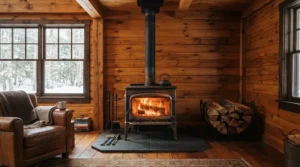
Stove capacity for cabin size is where first-time buyers most often slip, usually by trusting floor area. Volume is what the stove must heat, and glazing, masonry or poor insulation all add to it.
Take a cabin of 2.4 × 2.0 × 2.1 metres: about 10 m³. Add a glass door and Harvia’s method pushes that towards 11.5 m³, comfortably inside the range of the Harvia M3, Narvi Kuru 14 and Harvia Legend 150. Now a larger 3.0 × 2.5 × 2.3 metre cabin with a picture window: 17.25 m³ before the glass, so perhaps 19–20 m³ adjusted. That’s right at the ceiling of the Harvia Pro 20 and Narvi NC 20, so this is where I’d sooner step up to the Narvi NC 24 (rated up to about 24 m³) than gamble on an over-stretched stove.
Undersizing is obvious: the cabin never quite gets there. Oversizing is subtler: the stove burns in short, hot bursts, overheating the room and wasting wood. Get stove capacity for cabin size right by aiming for the middle of the rated band, and be honest about insulation.
Stone Capacity and Steam: Why Rock Mass Decides Your Löyly
Stone capacity and steam are joined at the hip. Stones store heat, so more rock means steadier temperatures and softer, longer-lasting steam when you ladle water. It’s why HUUM built a rock basket around its stove, and why editorial guides note that stone-heavy stoves such as the HUUM HIVE Wood 17 and Harvia Legend 150 take longer to warm but hold heat longer.
Two practical rules follow. First, always load the manufacturer’s minimum stone quantity; running a stove without enough mass produces poor steam and can damage it. Second, use the stones specified: Harvia uses olivine diabase in a 10–15 cm grade for wood stoves, and Narvi specifies 4–6 inch split-face olivine diabase.
| Stove | Stone mass | Heat-up (relative) | Steam character | Best For |
|---|---|---|---|---|
| Harvia M3 | ~30 kg | Quick | Livelier, sharper | Small barrels |
| Narvi Kuru 14 | ~35 kg | Quick | Balanced | Tight layouts |
| Harvia Pro 20 | 40 kg | Quick | Hearty, drier | Fast heat-ups |
| Harvia Linear 22 GreenFlame | 40 kg | Quick to balanced | Balanced | Cleaner-burn seekers |
| Narvi NC 20 | ~60 kg | Balanced | Soft, even | Mid-to-large cabins |
| Harvia Legend 150 | up to 120 kg | Slower | Soft, long-lasting | Steam lovers |
| HUUM HIVE Wood 17 | 130 kg | Slower | Softest, longest | Steam purists |
The pattern is unsubtle: more stone, slower start, softer steam that lasts. If you sauna for long weekend sessions, that’s a feature; if you want a quick 30-minute blast after work, it’s a tax. The “relative” heat-up column is my inference from stone mass and editorial guidance, not lab data, so treat it as directional.
Clearance and Safety Distances: What Manuals and UK Rules Say
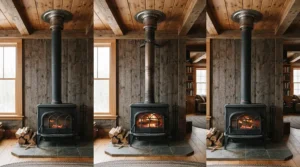
Clearance and safety distances are the difference between a lovely sauna and an insurance claim. Every stove’s manual sets minimum distances to combustible walls, benches and ceilings, and the listed numbers vary widely: 25 cm at the sides and back for the Narvi Kuru 14, 400 mm all round for the Harvia Linear 22 GreenFlame, and 500 mm and 1,000 mm values on different faces for the HUUM HIVE Wood 17.
Shielding changes the maths. Narvi’s protective walls halve distances on compatible stoves such as the Narvi NC 20, the Harvia Linear 22 GreenFlame drops to about 110 mm with its shield, and Harvia’s WL450 sheath is approved for the Harvia M3 and Harvia M3 SL. Narvi’s manuals also call for 1,000 mm around an uninsulated smoke flue, floor protection where floors are combustible (metal sheet extending at least 400 mm in front), and firewood below 20% moisture.
My analytical take: always design the bench layout around the manual’s clearance and safety distances first, then choose the stove, not the other way round. Shielding is a solution, not a licence to improvise.
UK Building Regulations, Smoke Control Areas and Flues
In England, solid-fuel appliances fall under Approved Document J, which covers air supply, discharge of combustion products and protection of the building. Suppliers note it applies to cabins and outbuildings too. Wales, Scotland and Northern Ireland have their own rules, so check locally.
Flue positions matter. Guidance summarised by suppliers says a terminal within 2.3 m of an adjacent building should sit at least 600 mm above it, and twin-wall flues passing through storage spaces must be boxed in. Carbon monoxide alarm rules were extended in October 2022 for new or replacement solid-fuel appliances in dwellings; for a garden cabin, ask building control. Note that ordinary CO alarms are rarely rated for sauna heat, so placement is a job for a competent installer.
Smoke control areas are the sting in the tail. Under gov.uk’s rules you may face a penalty of up to £300 in England if your chimney emits smoke there, and a chimney on a summerhouse counts. One UK supplier reports that most wood-fired sauna stoves aren’t on the Defra exempt list, so verify before ordering. Compliance overheads of £2,000–£4,000 on top of cabin and stove have been quoted by one UK supplier, so budget accordingly.
Wood Burning Sauna Stove vs Electric Heater: Which Fits Your Garden?
| Factor | Wood burning sauna stove | Electric heater |
|---|---|---|
| Heat and steam feel | Radiant, layered, ritual | Consistent, easily controlled |
| Installation | Chimney, clearances, Doc J | Electrical work (notifiable under Part P) |
| Smoke control areas | Often restricted | No combustion, no issue |
| Off-grid use | Excellent | Needs power |
| Best For | Rural or off-grid gardens, tradition-lovers | Urban plots, convenience-seekers |
Neither is “better”, they suit different lives. A wood burning sauna stove rewards you with atmosphere and independence, at the cost of chimneys, paperwork and log wrangling. An electric heater with a rock basket delivers proper löyly without combustion, which is why it’s the pragmatic route inside a smoke control area. If you’re rural, own a woodpile and enjoy the ritual, choose wood. If you’re on a terraced plot with neighbours 2 m away, electric is probably the kinder answer.
Real-World Scenarios: Which Stove Fits Which Cabin?
Scenario 1: A barrel in a small garden. Roughly 9 m³ adjusted, used twice a week, budget around £1,500 all-in. The Harvia M3 or Narvi Kuru 14 fit; choose the Narvi Kuru 14 if bench clearance is tight, and confirm your smoke control status before anything else.
Scenario 2: A family cabin with a glass wall. About 17 m³ of room plus glazing, weekend use with several bathers. The Harvia Pro 20 heats fast in a leaky room; the Narvi NC 20 adds stone headroom and steadier heat. With a budget nearer £2,500 all-in, the Narvi NC 20 is the calmer choice.
Scenario 3: A design-led retreat, about 12 m³. Long, slow sessions, budget flexible. The HUUM HIVE Wood 17 delivers the softest, longest steam; the Harvia Legend 150 is the more conventional alternative at a lower price. Either way, ensure the floor supports 120–130 kg of stones.
These are illustrative profiles built from the spec data, not customer case studies.
Practical Guide: First Firing, Stones and Maintenance
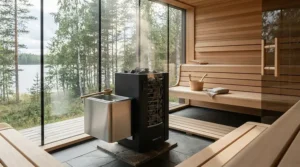
- Stack stones loosely. Leave gaps for airflow, larger stones at the bottom, and use the manufacturer’s specified size and quantity.
- Do a gentle first burn. New stoves can smell as coatings cure, so ventilate well. Narvi advises removing loose cover material from the stone compartment with a steel brush after the first preheat.
- Burn dry wood only. Under 20% moisture, per Narvi’s manual, and never treated waste wood.
- Empty ash when cold. Never with embers, and never into combustible bins.
- Re-stack yearly. Replace cracked stones so heat still flows evenly.
- Sweep the chimney annually. Document J-related guidance and most insurers expect it.
- Test your CO alarm. Monthly, in the position your installer specified.
First-month mistakes worth avoiding: overfilling the firebox to “speed things up” (it just overheats), and pouring big volumes of water at once (it cools the stones and shocks bathers).
Common Wood Burning Sauna Stove Problems and Fixes
Problem: It won’t reach temperature. Recalculate adjusted volume, check stone quantity and wood dryness, and confirm the chimney is drawing. A stove at the top of its range in a glass-heavy cabin will always struggle.
Problem: Steam feels harsh and dry. Usually too little stone mass or stones too small. A lean-stone stove like the Harvia Pro 20 benefits from smaller, more frequent ladles.
Problem: Smoke spills into the room. Prime a cold flue by warming it first, and check terminal height and draught with your installer.
Problem: Cladding scorches. That’s a clearance and safety distances issue. Fit the approved shield for your model, such as Harvia’s WL450 for the Harvia M3.
Problem: You’re in a smoke control area. Check the Defra list of exempt appliances before buying. If your stove isn’t listed, switch to an electric heater.
Wood Burning Sauna Heater Review: What Owners Report and What It Costs to Run
Every honest wood burning sauna heater review should admit what it can’t verify. Product-specific owner feedback for several of these stoves is thin, so this is an aggregate of retailer pages and editorial verdicts, not a poll.
The recurring positives are consistent: heat quality, the glass-door glow, and build quality. The recurring gripes are equally consistent: stones and chimney kits sold separately, pallet deliveries for heavy stoves, and cost.
So which are the top rated wood burning sauna stoves? Editors disagree. One 2026 guide names the Harvia Pro 20 best for most home saunas and the Narvi NC series best for large ones; another leads with the HUUM HIVE Wood 17; a supplier’s guide picks the Harvia M3 GL. That spread tells you the “best” depends on your cabin, not the badge.
Running costs are dominated by seasoned wood, annual chimney sweeping and eventual stone replacement, alongside the installation and compliance costs covered earlier. Be sceptical of anyone quoting neat annual figures without knowing your session frequency.
FAQs
❓ How long does a wood burning sauna stove take to heat a cabin?
❓ Can you heat water with a wood burning sauna stove?
❓ Do wood burning sauna stoves need a chimney?
❓ Can I load a wood burning sauna stove from outside the cabin?
❓ What wood is best for a wood burning sauna stove?
Conclusion
Strip away the marketing and the choice simplifies. Under roughly 13 m³ with a modest budget, the Harvia M3 is the benchmark and the Narvi Kuru 14 is the space-saver. For mid-size cabins that leak heat, the Harvia Pro 20 delivers speed. If steam softness is your obsession, the Harvia Legend 150 and HUUM HIVE Wood 17 reward patience with long, mellow heat, while the Narvi NC 20 balances stone mass and headroom for larger rooms. The Harvia Linear 22 GreenFlame is the tidy-burning outlier for style-led builds.
Before you buy, do the unglamorous homework: measure adjusted volume, check clearance and safety distances against your layout, confirm smoke control status with your council and budget for stones, chimney and installation. Do that, and the stove stops being a gamble and becomes what it should be: a slow, rolling, crackling reason to look forward to Sunday evening.
✨ Ready to light the fire?
🔥 Compare your shortlisted Harvia, Narvi and HUUM stoves, check current pricing and availability, and bring the real Finnish löyly home. Your future self, warm to the bone, will thank you!
Recommended for You
- Wood Burning Saunas: 7 Best Buys For UK Gardens (2026)
- Wood Burning Sauna For Garden: 7 Best UK Picks (2026)
- Electric Sauna Cabin For Home: 7 Best UK Picks (2026)
Disclaimer: This article contains affiliate links. As an Amazon Associate, I earn from qualifying purchases. If you purchase products through these links, we may earn a small commission at no additional cost to you.
✨ Found this helpful? Share it with your friends! 💬🤗
