
In This Article
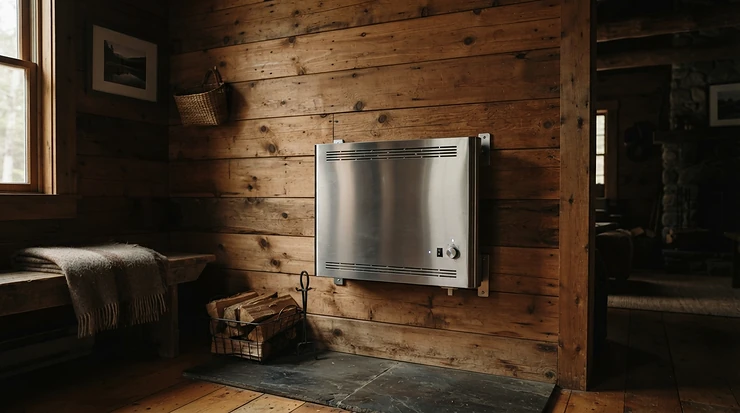
What is a Finnish sauna heater? It is the kiuas: an electric or wood-fired stove that heats a mass of stones until a ladle of water turns into löyly, the soft, rolling steam that defines a Finnish sauna. In short, a Finnish sauna heater is judged by its stones as much as its kilowatts.
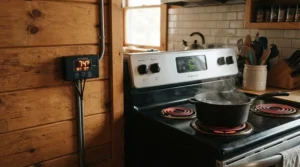
Most people shop for a sauna the wrong way round. They fall for the cabin, with its honey-coloured timber, glass front and neat little towel hook, and treat the stove as an afterthought. Then the first session arrives, the steam is thin and angry, and the lovely cabin smells faintly of regret.
Here’s the thing: your Finnish sauna heater is the engine, the fireplace and the personality of the room rolled into one stainless-steel box. Choose well and a modest garden cabin feels like a Finnish lakeside retreat. Choose badly and it never quite gets there.
This Finnish sauna stove review is written for British buyers. It uses real manufacturer specifications and honest analysis rather than hype. I compare seven well-known models, from a compact budget wall unit to a premium air-blending system. Along the way we dig into stone loading capacity, heater positioning in cabin layouts, the recommended heat-up duration to plan around, and which top rated Finnish sauna cabins pair sensibly with each stove.
One honest note up front: I haven’t handled any of these heaters, and I couldn’t verify deep pools of UK customer reviews for every model. Where evidence is thin, I say so. I then fill the gap with specifications, UK electrical context and value reasoning.
Finnish Sauna Heater Quick Comparison: 7 Models, One Table
Before the detail, here is the whole field at a glance. Room sizes and stone weights come from manufacturer or distributor data, so treat them as corridors rather than guarantees.
| Heater | Type | Output | Stone capacity | Rated room size | Best For |
|---|---|---|---|---|---|
| Harvia Vega BC60 | Wall, electric | 6 kW | 20 kg | 5–8 m³ | Small budget cabins |
| Harvia M3 | Wood-burning | 16.5 kW | 30 kg | 6–13 m³ | Off-grid garden cabins |
| Harvia Spirit SP90E | Wall, electric (separate control unit) | 9 kW | 60 kg | 8–14 m³ | WiFi-ready family cabins |
| Harvia Cilindro PC90 | Floor pillar, electric | 9 kW | 80 kg | 8–14 m³ | Steam purists |
| Harvia Virta HL90 | Floor-standing, electric (separate control unit) | 9 kW | 50 kg | 8–14 m³ | Frequent, long sessions |
| HUUM Drop 9kW | Wall, electric | 9 kW | 55 kg | 8–15 m³ | Design-led cabins |
| Saunum AIR 5 | Electric with air-blending fan | 4.8 kW | 60–70 kg | 3–5 m³ | Compact cabins, even heat |
Read down the stone column and a pattern jumps out. The Harvia Cilindro PC90 carries roughly four times the stones of the Harvia Vega BC60, which is why two “Harvia” heaters feel so different in use. If your cabin is under 5 m³, the Saunum AIR 5 is the only model here sized for it. From 8 m³ upwards, the 9 kW class takes over.
💬 Just one click — help others make better buying decisions too!😊
Top 7 Finnish Sauna Heater Picks: Finnish Sauna Stove Review for 2026
1. Harvia Vega BC60 — compact budget wall heater for small cabins
Small cabins deserve a small stove, and the Harvia Vega BC60 is built on exactly that logic. This 6 kW stainless-steel wall unit is rated for rooms of 5–8 m³ and holds 20 kg of 5–10 cm stones. In practice, that modest stone load means a quicker pre-heat but a shorter, sharper burst of löyly, closer to a firm gust than a slow, rolling cloud. Harvia’s data also lets you mount it low on the wall so the lower bench gets its share of steam. The switches can sit on either side, which rescues awkward layouts.
Based on the spec comparison, the Harvia Vega BC60 suits a two-person indoor cabin or compact garden unit where budget matters more than ceremony. Clearances are tight (30 mm at the front, 50 mm at the sides), but the 1.1 m gap above the heater means your cabin needs at least 1.9 m of height. One more thing the spec sheet hides: 6 kW is roughly 26 A on a single-phase 230 V supply, so have an electrician confirm the circuit.
I couldn’t verify a meaningful pool of Amazon UK reviews for this exact model, so I won’t invent a consensus. What is verifiable is that a Finnish distributor lists a ten-year spare-parts window after discontinuation, which is quietly reassuring for something you’ll keep for years.
Pros:
- ✅ Compact body suits small cabins
- ✅ Low mounting helps lower benches
- ✅ Tight clearances save valuable floor space
Cons:
- ❌ Only 20 kg of stones limits steam
- ❌ Stones and wiring cost extra
Price: around £250–£350 for the heater alone (check current price), which is good value for rooms under 8 m³.
2. Harvia M3 — wood-fired classic with a glass door
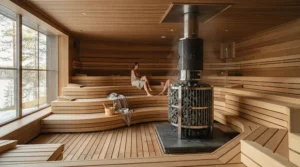
Some people want electrons; others want fire. The Harvia M3 is for the second camp: a graphite-black wood-burning stove whose glass door makes the flames part of the show. Harvia rates it for 6–13 m³ rooms, with a 16.5 kW output and space for 30 kg of larger 10–15 cm stones. That output looks enormous beside a 9 kW electric, but it describes peak firing power rather than steady draw. The stove’s 45 kg steel body and stone load then smooth the heat out as the fire settles.
On paper, this is the pick for garden or off-grid cabins with no sensible electrical supply, and for anyone who believes a sauna should smell faintly of woodsmoke. The trade-offs are real, though. You need a correctly installed 115 mm flue, dry fuel, patience, 300 mm of clearance at the front and at least 1.3 m above the stove to the ceiling. Flues fall under Building Regulations, so speak to Building Control or a competent solid-fuel installer before buying.
Buyer guides describe it as widely considered the world’s best-selling wood-fired sauna stove. That is a popularity signal rather than a verified satisfaction score, and I couldn’t verify detailed UK review themes.
Pros:
- ✅ No electrical connection required
- ✅ Glass door adds genuine firelight atmosphere
- ✅ Optional pipe water heater fits the flue
Cons:
- ❌ Needs flue, fuel storage and a competent installer
- ❌ 30 kg stone load is modest for this output
Price: roughly £400–£550 for the stove alone (stones and flue kit extra; check current price), which is strong value if mains power isn’t an option.
3. Harvia Spirit SP90E — sculpted wall heater with WiFi-ready control
Sauna stoves are rarely called elegant, yet the Harvia Spirit SP90E earns it, with curved lines that frame the stones like a gallery piece. It’s a 9 kW wall-mounted heater made in Finland and rated for 8–14 m³. It holds up to 60 kg of stones, and Harvia recommends roughly 55 kg of 5–10 cm olivine diabase. That is a big stone mass for a wall unit, and it’s what turns a slim electric into something that makes soft löyly. Built-in ventilation channels cool the wall behind it and keep air moving through the elements, which helps temperatures stay even.
Analytically, this is the pick for a family-sized cabin where you want to start the session from your phone. The heater carries its own integrated safety system, so remote starting doesn’t need extra devices. The control unit (Xenio, C-Series or selected Fenix models) is sold separately, so budget for it. The minimum room height is 190 cm, which is worth checking before you fall in love.
I couldn’t find enough UK review data to summarise responsibly. Treat the WiFi and design claims as manufacturer positioning until you’ve read the live Amazon UK reviews.
Pros:
- ✅ 60 kg stone capacity in a wall-mounted body
- ✅ Built-in safety suits remote starting
- ✅ Ventilation channels help even out temperature
Cons:
- ❌ Control unit sold separately
- ❌ Stones aren’t included
Price: around £600–£800 for the heater alone (control unit and stones extra; check current price), which is fair value for a design-led Finnish build.
4. Harvia Cilindro PC90 — Finland’s long-running pillar of stones
Look at it and you see a stainless-steel tower. Look closer and you see a very large pile of rocks with the elements hiding at its core. The Harvia Cilindro PC90 is a 9 kW floor-standing pillar rated for 8–14 m³ rooms. It holds around 80 kg of stones on the manual version (90 kg on the separate-control E model). That is the biggest stone mass of the seven heaters here, which is why this design suits people who care about löyly more than gadgets. The grated shell also lets you shape the steam: water on the side gives a soft wave, water on top gives a sharp snap.
Based on the spec comparison, this is the heater for long sessions and a proper stone-driven feel. Harvia says it can be embedded in a bench or placed in front of a glass wall, so it’s flexible when the stove should be a feature. Remember the loaded weight, though: around 90 kg all-in means you should check the floor as well as the wall.
A retailer describes the Cilindro as Finland’s best-selling heater for almost a decade. That is a seller’s claim I couldn’t independently verify, and I couldn’t verify detailed UK review themes either.
Pros:
- ✅ 80 kg of stones for soft, long steam
- ✅ Two steam characters from one heater
- ✅ Embeds into bench or glass-wall layouts
Cons:
- ❌ Heavy loaded weight needs a solid floor
- ❌ Larger stone mass generally pre-heats more slowly
Price: indicatively £650–£900 for the heater alone (check what’s included and current price), which is strong value if steam quality is the priority.
5. Harvia Virta HL90 — easiest to service, built for daily sessions
Heaters rarely fail dramatically. They fail awkwardly, with a hunt for a tradesperson and a stack of stones to lift out first. The Harvia Virta HL90 is designed around that annoyance. It’s a 9 kW floor-standing electric heater for 8–14 m³ rooms, holding 50 kg of larger 10–15 cm stones. The elements are separated from the stones, and the whole element module pulls out through a front maintenance hatch. In plain English: repairs are simpler, and the elements sit away from stone debris, which Harvia says lengthens their life.
On paper, this is the heater for people who sauna often, and Harvia lists professionals among its intended users as well as households. Being floor-standing, it needs more room than a wall unit, so it suits medium cabins better than narrow ones. Larger stones generally last longer between restacks but heat more slowly than small ones, so factor that into your pre-heat plan.
I couldn’t verify enough Amazon UK feedback to summarise. What is checkable is that the serviceability claims come straight from Harvia’s design notes, so any installer can confirm them before you buy.
Pros:
- ✅ Pull-out element module simplifies repairs
- ✅ Elements isolated from the stones
- ✅ Sturdy build suits frequent use
Cons:
- ❌ Bigger footprint than wall heaters
- ❌ Control unit sold separately
Price: indicatively £800–£1,100 for the heater alone (check current price), which is good value for heavy users who dread callouts.
6. HUUM Drop 9kW — design-award teardrop with 55 kg of stones
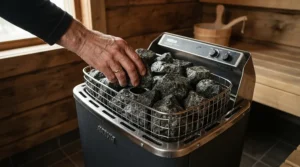
Plenty of heaters hide their stones. The HUUM Drop 9kW shows them off inside a teardrop of stainless steel that won a Red Dot product design award in 2015. It’s a 9 kW wall heater for 8–15 m³ rooms, carrying 55 kg of 5–10 cm stones in a body that weighs around 12 kg empty and measures 590 × 390 × 335 mm. The practical translation is a big stone mass in a slim shape, which suits cabins where floor space is precious. The datasheet calls for a 16 A fuse on a 400 V three-phase supply with 5 × 2.5 mm² cable, so UK installs need an electrician’s eye.
An honest flag: HUUM is Estonian, not Finnish. It does the same job as a Finnish sauna heater, but if “made in Finland” matters to you, the Harvia models above are the better fit. For glass-fronted cabins where the stove is part of the décor, it’s the prettiest option here. A retailer listing also claims a pre-heat of roughly 20–30 minutes with WiFi control, which I’d treat as a best-case figure.
The Red Dot award recognises design rather than owner satisfaction, and one US retailer calls this its best-selling HUUM model. I couldn’t verify UK review themes.
Pros:
- ✅ 55 kg of stones in a slim wall unit
- ✅ Award-winning look suits glass-front cabins
- ✅ Three-year private-use warranty listed by one retailer
Cons:
- ❌ Estonian-made rather than Finnish-made
- ❌ Stones and control unit bought separately
Price: roughly £900–£1,300 for the heater alone (check current price), which is fair value if design is the deciding factor.
7. Saunum AIR 5 — air-blending heater for tiny cabins
Most heaters give you a hot head and cool ankles. The Saunum AIR 5 tries to fix that with a fan. Its patented module draws hot air from near the ceiling, mixes it with cooler floor air and redistributes it, and Saunum claims this evens room temperature by more than 60%. It’s a 4.8 kW heater for 3–5 m³ cabins that holds a hefty 60–70 kg of stones and weighs around 48 kg. On paper, that stone mass is huge for a 4.8 kW element, which should mean soft steam but a slower pre-heat.
In practice, this is the pick for compact garden cube cabins and cellar conversions, where a conventional heater would overpower the room. I couldn’t confirm a Finnish manufacturing origin, so I treat it as Finnish-style in function rather than in provenance. The extras are real too. Listings I reviewed show the controller and stones sold separately, and the fan is one more component to maintain.
The air-blending benefit is a manufacturer claim. I found no independent temperature measurements, so treat it as promising but unproven.
Pros:
- ✅ Fan evens head-to-toe temperatures
- ✅ Large 60–70 kg stone load
- ✅ Right-sized for 3–5 m³ rooms
Cons:
- ❌ Fan and controller add cost and complexity
- ❌ Slower pre-heat likely with this stone mass
Price: premium tier. I couldn’t verify a reliable UK price, so check current price before budgeting. Value depends on whether even heat is your priority.
Price and Value Round-Up
| Heater | Indicative price (heater only) | Extras to budget | Best For |
|---|---|---|---|
| Harvia Vega BC60 | £250–£350 | Stones, wiring | Small, budget cabins |
| Harvia M3 | £400–£550 | Stones, flue kit, installer | Off-grid wood fans |
| Harvia Spirit SP90E | £600–£800 | Control unit, stones | WiFi-ready family cabins |
| Harvia Cilindro PC90 | £650–£900 | Check what’s included | Steam purists |
| Harvia Virta HL90 | £800–£1,100 | Control unit, stones | Frequent users |
| HUUM Drop 9kW | £900–£1,300 | Stones, control unit | Design-led cabins |
| Saunum AIR 5 | Premium; verify current price | Controller, stones | Tiny cabins, even heat |
Price tracks stone mass and finish more than raw kilowatts. The Harvia Vega BC60 and Harvia M3 are the value anchors, while the HUUM Drop 9kW and Saunum AIR 5 charge for design and technology. I’ve left star ratings out deliberately because they change daily and I couldn’t verify them reliably, so read the live Amazon UK reviews before buying.
Your First 30 Days: A Practical Setup and Stone-Loading Guide
Most sauna disappointments begin on day one, not in year three. Here is a sequence worth following.
- Get the supply sorted first. A qualified electrician should size the circuit and fit a suitable isolator. As a guide, 6 kW draws roughly 26 A and 9 kW roughly 39 A on single-phase 230 V.
- Respect the stone loading capacity. Follow your manual: stack loosely, keep the elements fully covered, leave air gaps and keep stones clear of sensors. Harvia warns that an inadequately filled stone space is a fire risk.
- Burn off the factory smell. One Harvia-heater guide suggests a brief first run with the door open so the protective coating on the elements burns away. Check your manual and ventilate well.
- Keep early sessions short. Harvia’s manual advises against staying in more than 30 minutes at a time.
- Diarise maintenance. Harvia’s manual calls for annual stone cleaning and restacking, removing crumbled pieces. Many guides suggest replacing stones every year or two.
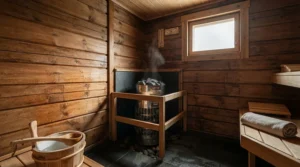
Common mistakes in the first 30 days are depressingly predictable. People hang towels over the stove, which disrupts airflow. They throw too much water at once, so the steam arrives like a slap. And they forget that wet timber needs time to dry. Give the cabin a gap between sessions and it will repay you with years of service.
Real-World Scenarios: Matching Heater to Home and Habit
These are illustrative profiles built from the specifications above, not anecdotes.
Scenario 1: The terraced-house cellar (about 3.8 m³)
Imagine a cellar room measuring 1.4 × 1.3 × 2.1 m, used twice a week by two adults. The Harvia Vega BC60 is rated from 5 m³, so it would be oversized and prone to overheating the space. The Saunum AIR 5 (3–5 m³) is the better match, and its fan helps in a low, enclosed room. Premium heater, small room: that’s the trade.
Scenario 2: The family garden cabin (about 9 m³)
Picture a 2.2 × 2.0 × 2.1 m cabin used by four people most weekends. The Harvia Spirit SP90E sits inside its 8–14 m³ range, carries 60 kg of stones for repeat löyly, and can be started from a phone before anyone changes. Add the control unit, stones and an electrician to the budget.
Scenario 3: The off-grid allotment cabin (about 7 m³)
A weekend-only cabin with no mains supply points to the Harvia M3, comfortably inside its 6–13 m³ range. Budget for flue, fuel and a competent installer. With low frequency of use, the wood routine becomes part of the pleasure.
Scenario 4: The showpiece with a glass wall (about 10 m³)
Glass loses heat faster than timber, so manufacturers’ sizing tools usually add volume for it. For a design-led 10 m³ cabin, the HUUM Drop 9kW or Harvia Cilindro PC90 can stand in front of the glass as a feature. Choose the Harvia Cilindro PC90 if steam matters most, or the Harvia Virta HL90 if daily use and easy servicing matter more.
✨ Handpicked Heaters Worth a Look!
🔍 Take your home sauna to the next level with these carefully selected models. Click on any highlighted product name to check current pricing and availability. The right stove will help you create the authentic löyly your whole household will love!
How to Choose a Finnish Sauna Heater: 7 Steps That Prevent Regret
To choose a Finnish sauna heater, calculate your cabin’s volume in cubic metres. Then match it to the heater’s rated range, and check your electrical supply, stone capacity, controls and clearances.
- Measure the volume. Length × width × height, in metres. This single number drives everything else.
- Apply the rule of thumb. HUUM’s sizing standard is 1 kW per 35 cubic feet, which is roughly 1 kW per m³. Size up if the cabin has glass or uninsulated surfaces.
- Check your supply. A 6 kW heater draws about 26 A and a 9 kW heater about 39 A on single-phase 230 V. Many Harvia models list both single-phase and three-phase wiring options, so confirm which suits your home.
- Compare stone mass. More stones mean softer steam and a slower pre-heat.
- Decide how you’ll control it. Built-in dials are simple, while separate control units add timers and WiFi.
- Plan the clearances. Safety distances decide where the heater can physically go.
- Budget for extras. Stones, control unit, safety rail and electrician can add substantially to the heater price.
Stone Loading Capacity: Why Kilograms Often Beat Kilowatts
Kilowatts tell you how fast a heater can heat. Stone loading capacity tells you how the room feels once water hits the rocks. Think of the stones as a battery for steam: the bigger the battery, the gentler and longer-lasting the release.
The league table
From lightest to heaviest, the stone loads here are the Harvia Vega BC60 (20 kg), Harvia M3 (30 kg), Harvia Virta HL90 (50 kg), HUUM Drop 9kW (55 kg), Harvia Spirit SP90E (60 kg), Saunum AIR 5 (60–70 kg) and Harvia Cilindro PC90 (80 kg).
A ceiling, not a target
Stone loading capacity is a maximum. Harvia’s manual warns that an inadequately filled stone space creates fire risk. Equally, a heating guide notes that packing stones too tightly restricts airflow and strains the heater. Follow the manual’s stacking pattern rather than improvising.
Size and type matter too
Manuals specify stone sizes: 5–10 cm for most electrics here, 10–15 cm for the Harvia M3 and Harvia Virta HL90. Harvia’s wall-heater manual recommends peridotite, olivine or olivine dolerite. HUUM suggests four 15 kg boxes for the HUUM Drop 9kW, which is a handy reminder that stones are a separate purchase. Finally, 80 kg of stones is a structural load, so check what your floor or bench can carry.
Heater Positioning in Cabin: Where the Stove Should Go
Heater positioning in cabin design is where good heaters get quietly sabotaged. The same stove can feel generous in one layout and mean in another.
Distance rules come first
Safety distances are non-negotiable. The Harvia Vega BC60 needs 30 mm at the front, 50 mm at the sides, 100 mm to the floor and 1.1 m to the ceiling. The Harvia M3 needs 300 mm at the front and at least 1.3 m above it. Harvia also warns against placing anything near the heater that changes airflow, because that can overheat the elements.
Layout rules come second
A common guide suggests placing the heater near the door or in a corner, so cooler entrance air mixes with warm air as it circulates. Keep the surroundings clear. Mounting a wall unit low, as the Harvia Vega BC60 allows, helps lower benches share the steam.
Special cases
The Harvia Cilindro PC90 can be embedded in a bench, which saves space but needs careful planning. The Saunum AIR 5 relies on its fan module, so its placement must leave room for air intake. In every case, a safety rail is worth considering where bathers may brush past a hot stove.
Recommended Heat-Up Duration: How Long to Wait Before You Step In
The recommended heat-up duration for most electric heaters is roughly 30–60 minutes. Plan around that and you’ll rarely be disappointed.
Typical numbers
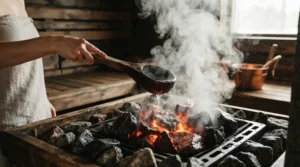
A Harvia kit retailer says its cabins typically reach 74°C in 30–40 minutes and 85°C in under an hour. Its standard guidance is 45–60 minutes to reach 77–85°C. Harvia’s own wall-heater manual advises allowing at least 30 minutes. A retailer listing for the HUUM Drop 9kW claims 20–30 minutes with WiFi control, which I’d treat as best-case.
What changes the number
Cold weather, outdoor cabins and large stone masses all stretch the wait. A heater like the Harvia Cilindro PC90 will generally take longer than the Harvia Vega BC60, but hold its heat more gently. I couldn’t find reliable timing data for the Harvia M3, because a wood stove depends on fuel, draught and technique.
After heat-up: session length
A widely discussed Finnish cohort study in JAMA Internal Medicine associated more frequent sauna bathing with lower cardiovascular risk. It was observational, and the authors called for further research. It is not medical advice, so check with your GP if you have heart or blood-pressure concerns.
Top Rated Finnish Sauna Cabins: Matching the Cabin to the Heater
A caution first: I couldn’t find independent UK rating data for cabins. Treat “top rated” as shorthand for “frequently recommended in buyer guides”.
Brands that keep appearing
Finnmark is a UK outdoor sauna specialist whose range includes the EMBA two-person cabin and a Thermo Wood Cube Mini with a 145 × 133 cm footprint. Auroom builds indoor and outdoor cabins in Estonia from thermally modified timber. TyloHelo combines Swedish and Finnish heritage. One retailer notes that Harvia owns Almost Heaven, so comparing a Harvia heater with an Almost Heaven cabin is not a truly independent second opinion.
Match volume, not just looks
A cabin with a 145 × 133 cm footprint and roughly 2 m of internal height is about 3.9 m³, assuming those dimensions. That falls inside the Saunum AIR 5 range but below the minimum of the Harvia Vega BC60. Always check the cabin’s actual internal volume against the heater’s rated range. Also confirm that the cabin’s wall construction allows the heater’s clearances, and that outdoor cabins use a heater rated for outdoor conditions.
Finnish Sauna Heater vs Alternatives: Electric, Wood or Infrared?
Choosing a Finnish sauna heater means choosing a heat source. Each option suits a different household.
| Option | Heat-up | Steam (löyly) | Setup | Best For |
|---|---|---|---|---|
| Electric, e.g. Harvia Spirit SP90E | Typically 30–60 minutes | Yes, stone-dependent | Electrician and control unit | Convenient weeknight sessions |
| Wood-burning, e.g. Harvia M3 | Varies with the fire | Yes, flame-fed | Flue, fuel and installer | Off-grid atmosphere |
| Infrared cabin | Varies by maker | No stones, so no löyly | Varies by model | Low-humidity heat, not Finnish |
Electric wins on convenience, wood wins on atmosphere, and infrared is a different experience altogether. As one guide puts it, no rocks means no löyly. If steam is the point, an infrared cabin won’t deliver it, however good the build.
Long-Term Cost & Maintenance of a Finnish Sauna Heater
The heater price is only the opening bid. Running cost is simple arithmetic: kilowatts × hours × your tariff. A 6 kW heater at full power for a 45-minute pre-heat uses about 4.5 kWh. At an illustrative 25p per kWh, that is roughly £1.13 before the session itself, because the thermostat then cycles the elements.
Maintenance is modest but real. Many guides suggest replacing stones every year or two, and Harvia’s manual calls for annual cleaning and restacking. Element replacement is the bigger variable: the Harvia Virta HL90 makes it easy with a pull-out module, while a distributor lists a ten-year spare-parts window for the Harvia Vega BC60. A wood stove like the Harvia M3 swaps electricity for fuel, chimney care and a bit of physical effort.
When comparing total cost, include stones, control unit, electrician and any flue work. A cheaper heater that needs more upkeep can cost more over a decade than a sturdier one.
Safety, Regulations & Compliance Guide
Sauna heaters combine high power, high temperatures and water, so treat the installation seriously.
- Use a competent electrician. In England, electrical work in dwellings falls under Part P of the Building Regulations, explained in Approved Document P on gov.uk. Some work must be notified to building control.
- Check the wiring options. Many Harvia models list 230 V and 400 V connection options, but confirm which applies to your property.
- Ask about compliance marks. The Harvia listings I reviewed show CE certification, so ask the seller about UK marking for UK sale.
- Respect clearances and airflow. Don’t place objects near the stove that change airflow.
- Mind your session length. Harvia’s manual advises against exceeding 30 minutes at a time.
- Check your health first. Speak to your GP if you have heart or blood-pressure concerns, or are pregnant.
FAQ
❓ How much does a Finnish sauna heater cost in the UK?
❓ What size Finnish sauna heater suits a 6 m³ cabin?
❓ Can I run a 9 kW heater on a normal UK home supply?
❓ Is a wood-burning heater allowed in a UK garden?
❓ How often should I replace sauna stones?
Conclusion
The best Finnish sauna heater is the one that fits your cabin, your electrics and your habits. Everything else is decoration.
For small budgets and small rooms, the Harvia Vega BC60 is the sensible choice. If you’re off-grid, the Harvia M3 brings fire and flavour. For family cabins that want WiFi, the Harvia Spirit SP90E has the stone mass to back up the styling. Steam purists should look at the Harvia Cilindro PC90, and heavy users will appreciate the serviceability of the Harvia Virta HL90. If design is the deciding factor, the HUUM Drop 9kW is the showpiece, while the Saunum AIR 5 is the specialist for tiny cabins.
Whichever you choose, remember the lessons from this Finnish sauna stove review. Check stone loading capacity as carefully as kilowatts. Plan heater positioning in cabin layouts before you buy. Allow the recommended heat-up duration of 30–60 minutes. And match your heater to one of the top rated Finnish sauna cabins, or any cabin whose internal volume genuinely suits it.
✨ Ready to Choose Your Heater?
🔍 Click on any highlighted product name to check current pricing and availability on Amazon UK. Pick the stove that fits your cabin, and your first löyly will tell you it was worth the care!
Recommended for You
- Finnish Saunas Under £2500: 7 Best Picks For UK Gardens (2026)
- Finnish Sauna Kit For Home: 7 Best Picks For UK Gardens (2026)
- Wood Burning Sauna Stove: 7 Best Picks For UK Cabins (2026)
Disclaimer: This article contains affiliate links. As an Amazon Associate, I earn from qualifying purchases. If you purchase products through these links, we may earn a small commission at no additional cost to you.
✨ Found this helpful? Share it with your friends! 💬🤗
