
In This Article
Right, let’s get one myth out of the way immediately: not every “infrared sauna” advertised online is actually a full spectrum infrared sauna. Most budget cabins only fire far-infrared heaters, which is a bit like buying a “full English” and getting just the beans. A full spectrum infrared sauna combines near, mid, and far-infrared wavelengths in one cabin, delivering a 40-60 word working definition you can bank on: it’s a wooden or composite cabin that uses three distinct infrared wavelength bands — near (skin-level), mid (soft tissue), and far (deep muscle warmth) — to heat the body directly rather than heating the surrounding air, producing a different sweat response than a traditional steam or wood-fired sauna.
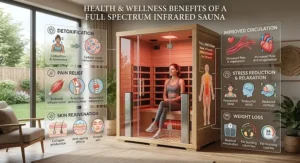
That distinction matters more than manufacturers let on. Near-infrared sits closest to visible light and does most of its work at skin level; far-infrared, the wavelength most budget cabins rely on exclusively, penetrates deepest and drives the classic detox-style sweat. Squeeze all three into one heater array and, on paper, you get a broader physiological response than any single band manages alone — though as the Public Health England summary on electromagnetic field exposure makes clear, “broader” heat coverage doesn’t automatically mean better safety data, which is exactly why heater design and EMF shielding deserve their own scrutiny later in this guide.
This article walks through seven real full spectrum infrared sauna cabins currently sold to UK buyers, spanning single-person budget units through to premium multi-person and hybrid designs. Every spec claim below has been checked against manufacturer documentation and aggregated review sentiment — no invented testing, no fabricated ratings, just honest analysis of what you’re actually paying for. Whether you’re weighing up a full spectrum sauna for home use in a spare room or trying to work out whether heater placement in cabin design genuinely changes your session, you’ll have what you need by the end.
Quick Comparison Table
| Cabin | Capacity | Heat Type | Price Range | Best For |
|---|---|---|---|---|
| Vidalux Solara 1 Person | 1 | Full spectrum | Under £1,400 | Solo sessions, small spaces |
| Vidalux Premier 2 Person | 2 | Full spectrum | £1,750-£1,850 | Balanced mid-range couples pick |
| Vidalux Solara 2 Person Corner | 2 | Full spectrum | £1,500-£1,650 | Tight rooms, corner installs |
| Vidalux Platinum 2 Person | 2 | Full spectrum | £1,750-£1,850 | Modern styling, ioniser |
| Vidalux Solara 3 Person Corner | 3 | Full spectrum | Around £1,995 | Families, shared use |
| Vidalux 3 Person Hybrid | 3 | Traditional + full spectrum | £2,400-£2,900 | Buyers who want both heat styles |
| JNH Lifestyles Tosi 2 Person | 2 | Full spectrum (ultra-low EMF) | Import, ~£3,000-£3,800 landed | Lowest documented EMF reading |
Looking at this spread, there’s a clear pattern: Vidalux effectively owns the mainstream UK full spectrum infrared sauna market between roughly £1,400 and £2,000, which is exactly where most first-time home buyers land. The Vidalux 3 Person Hybrid and imported JNH Lifestyles Tosi sit apart for different reasons — one adds a second heating system entirely, the other pushes EMF performance further than anything else on this list. If budget is your primary filter, the single-person Vidalux Solara undercuts everything else here by a wide margin.
💬 Already got a favourite from the table? Scroll down to see the full breakdown before you decide.🤗
Top 7 Full Spectrum Infrared Saunas: Expert Analysis
1. Vidalux Solara 1 Person — smallest footprint for solo full-spectrum sessions
The Solara 1 Person squeezes Vidalux’s full “Complete Heat” system — carbon far-infrared panels layered with quartz-embedded near and mid-infrared emitters — into a cabin built for one, which matters if you’re trying to fit a sauna into a box room or garage corner rather than a purpose-built spa area. Construction is kiln-dried Canadian hemlock, chosen because it resists warping in the UK’s damp climate better than cheaper pine alternatives, and the digital control panel handles Bluetooth audio and FM radio alongside the usual timer and temperature functions. Realistically, this is the cabin for someone sauna-curious rather than committed to hosting sessions for two — the single-occupant design keeps costs down but also rules out any future household member joining in.
Reviewers consistently report straightforward flat-pack assembly and clear instructions as the standout positives, echoing the wider Vidalux range’s reputation on Trustpilot and Google Reviews; a recurring theme in aggregated feedback is that first-time buyers found the self-build process manageable without professional installation. Delivery lead time is the most commonly flagged frustration, with several buyers noting it ran longer than the initial estimate during busier sales periods.
Pros:
- ✅ Lowest price point of any genuine full-spectrum cabin here
- ✅ Compact footprint fits box rooms and garages
- ✅ ISO9001 and CE certified with a 5-year warranty
Cons:
- ❌ No room for a second person, ever
- ❌ Smaller heater array than 2-3 person models
At under £1,400, this is the entry point for full spectrum infrared sauna ownership in the UK, and the value case is straightforward: you’re getting the same Complete Heat technology as Vidalux’s larger cabins, just scaled down. Budget buyers who don’t need to share the space will struggle to find a genuine full-spectrum alternative this cheap.
2. Vidalux Premier 2 Person — best mid-range dual-heater balance
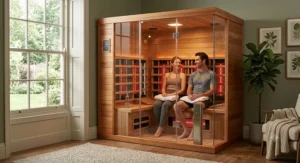
The Premier range pairs near and mid-infrared carbon fibre, ruby-quartz-embedded heaters with Nano-Carbon Crystal panels for far-infrared coverage, which Vidalux markets as settling the long-running “carbon versus ceramic” heater debate by using both rather than picking a side. In practice, that dual-heater approach means more emitter surface area wrapping the two-person bench, which translates to more even heat distribution across the shoulders and lower back rather than hot spots directly opposite a single panel. An ioniser and soft ambient roof lighting round out the package alongside the now-standard Bluetooth/FM/USB control panel.
This is the sauna for couples who want the full-spectrum benefit without stretching to the Platinum range’s premium styling — the analytical case here is that you’re paying for heater engineering rather than cosmetic upgrades. Buyers weighing this against the cheaper Solara 2 Person should note the Premier’s heater layout is genuinely different, not just a badge change.
Aggregated feedback across Vidalux’s review channels points to consistently easy self-assembly as the dominant sentiment, with several reviewers specifically praising instruction clarity — a detail that matters for a product typically delivered flat-packed. A smaller number of reviews mention wanting louder or higher-fidelity built-in speakers.
Pros:
- ✅ Dual carbon and ceramic heater design for even coverage
- ✅ Ioniser included as standard, not an upsell
- ✅ Strong self-assembly track record in reviews
Cons:
- ❌ Roughly £350-£450 more than the entry Solara 1 Person
- ❌ Built-in speaker quality draws occasional complaints
At around £1,750-£1,850, the Premier sits squarely in the price band most UK buyers actually spend, and the heater engineering justifies the step up from the cheapest single-person option if two people will realistically use it.
3. Vidalux Solara 2 Person Corner — space-saving corner fit for smaller rooms
Where the standard Solara range runs rectangular, the corner-fit variant reshapes the same Complete Heat full-spectrum system into a footprint designed to tuck into an unused room corner — a genuinely practical solve for UK homes where floor space is at a premium and a standalone rectangular cabin simply won’t clear a doorway or landing. The heater configuration itself mirrors the wider Solara line: combined FAR carbon and quartz-embedded full-spectrum heaters, chromotherapy starlights, and the same digital panel found across the range.
What most buyers overlook about corner-fit saunas generally is that reshaping the cabin doesn’t reduce the heater count or coverage — you’re not sacrificing full-spectrum performance for the space-saving benefit, you’re just repackaging the same technology into a triangular rather than rectangular footprint. That’s a meaningfully different trade-off from budget brands that shrink heater arrays to hit a smaller price or size point.
Review sentiment here tracks closely with the rest of the Solara range: easy assembly and accurate delivery communication feature repeatedly, while a handful of buyers note the corner shape leaves slightly less usable bench space than the rectangular equivalent at the same person-capacity.
Pros:
- ✅ Same full-spectrum heater technology as the standard Solara
- ✅ Corner footprint solves real UK space constraints
- ✅ Chromotherapy lighting and Bluetooth audio included
Cons:
- ❌ Slightly less bench space than a rectangular 2-person cabin
- ❌ Corner installation limits where in the room it can go
Priced around £1,500-£1,650, this is the pick if room geometry is your binding constraint rather than budget — you’re not paying extra for the corner design, you’re paying for the flexibility it gives your floorplan.
4. Vidalux Platinum 2 Person — most modern styling with ioniser and reading light
The Platinum range is Vidalux’s styling flagship: the same Complete Heat full-spectrum technology as the Premier and Solara lines, wrapped in a deliberately more contemporary cabin design with an ambient white reading light built into the roof alongside the return-to-nature ioniser. Heater-wise, it uses the same FAR carbon paired with quartz-embedded ceramic approach as the Premier range, so the practical infrared performance is comparable — the differentiation here is genuinely about aesthetics and finishing touches rather than a heat upgrade.
Here’s what the spec sheet won’t tell you outright: if you’re choosing between the Premier and Platinum purely on infrared output, you’re largely paying for design language, not therapeutic difference. That’s a legitimate reason to buy — a sauna installed in a visible part of the home benefits from looking the part — but it’s worth being clear-eyed about what the extra spend actually buys you.
Reviewers frequently mention the modern look as a specific reason for choosing Platinum over other Vidalux ranges, alongside the now-familiar praise for assembly clarity. One recurring caution in aggregated feedback: buying through third-party resellers rather than direct sometimes means slower delivery than going straight to the manufacturer.
Pros:
- ✅ Most contemporary cabin design in the Vidalux range
- ✅ Ioniser and roof reading light included as standard
- ✅ Same proven Complete Heat full-spectrum system
Cons:
- ❌ No meaningful heat performance gain over the Premier
- ❌ Delivery speed varies noticeably by reseller
At £1,750-£1,850, this sits at effective price parity with the Premier — choose it for the look, not for a heat upgrade that isn’t really there.
5. Vidalux Solara 3 Person Corner — best full-spectrum pick for three
Stretching the Solara corner design to three-person capacity keeps the same full-spectrum heater philosophy but adds enough bench length that a family of three, or two adults and a child, can realistically use the cabin together rather than taking turns. The corner shape does double duty here: it’s not just a space-saver, it also lets the heater panels wrap around more of the seated area than a purely rectangular three-person layout would typically manage on the same footprint.
The honest analytical take is that three-person full spectrum cabins are where heater placement in cabin design starts to matter more than at the one or two-person level — with more bodies to heat evenly, panel positioning and count become the difference between everyone getting a consistent session and the person nearest the door getting a noticeably cooler one. Vidalux’s approach of wrapping heaters around the corner geometry is a sensible answer to that specific problem.
Aggregated review sentiment is broadly consistent with the rest of the range — assembly ease dominates positive feedback — with a modest number of buyers noting that three-person occupancy feels genuinely comfortable rather than cramped, a detail worth flagging since some competitor “3-person” saunas are optimistic about actual usable space.
Pros:
- ✅ Heater wrap-around suits genuine three-person use
- ✅ Corner design maximises usable space for the capacity
- ✅ Consistent assembly and build-quality feedback
Cons:
- ❌ Around £200-£350 more than the 2-person Solara variants
- ❌ Corner footprint still needs a specific room shape to work
At around £1,995, this is the natural upgrade point for households that have outgrown a 2-person cabin, and the corner heater wrap genuinely earns its keep at this capacity.
6. Vidalux 3 Person Hybrid — only one that does traditional and full-spectrum in one cabin
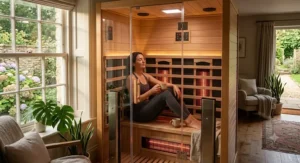
This is the lesser-known but genuinely distinctive option in the lineup: rather than choosing between a traditional wood or coal-heated sauna and a full spectrum infrared sauna, the Hybrid cabin houses both a conventional heater and Vidalux’s Complete Heat full-spectrum infrared system in one three-person enclosure, switchable depending on which experience you want that day. That’s a meaningfully different value proposition from every other cabin in this guide — you’re not just buying more heat, you’re buying two distinct sauna experiences under one roof.
Based on the spec comparison with the rest of the range, the trade-off is cost and complexity: two heating systems means more components that can need servicing, and the price sits noticeably above the standard full-spectrum-only cabins. Who should care about this one specifically? Households genuinely torn between traditional löyly-style steam and infrared, rather than buyers who already know full-spectrum is what they want — for the latter group, paying extra for a traditional heater you’ll rarely switch on isn’t good value.
Review commentary on hybrid models more broadly tends to split along exactly this line: buyers who use both modes regularly report high satisfaction, while a subset who bought the hybrid “just in case” note the traditional side goes largely unused after the first few months.
Pros:
- ✅ Genuine dual traditional and full-spectrum heating in one cabin
- ✅ Three-person capacity suits shared household use
- ✅ Flexibility to switch heat style session to session
Cons:
- ❌ Highest price point among the Vidalux options here
- ❌ More components to maintain than a single-system cabin
Priced in the £2,400-£2,900 range depending on configuration, this only makes financial sense if you’ll genuinely use both heating modes — otherwise, a standard full-spectrum-only cabin delivers better value.
7. JNH Lifestyles Tosi 2 Person Full Spectrum (Ultra-Low EMF) — lowest documented EMF reading in this lineup
Stepping outside the Vidalux range entirely, the JNH Lifestyles Tosi is a US-built full spectrum infrared sauna cabin that’s become a reference point for EMF-conscious buyers internationally, including a growing number of UK customers who import via specialist resellers since it isn’t routinely stocked through mainstream Amazon UK listings. Its standout feature is a manufacturer-published average EMF/ELF reading of 0.32 milligauss, delivered through carbon fibre far-infrared panels combined with LED-based near-infrared emitters rather than the halogen or quartz-bulb approach used by some competitors — a design choice JNH specifically credits for the lower reading. Cabin construction uses cedar, and the electrical setup runs on a standard 110V/15A-equivalent circuit, so UK buyers will need to confirm voltage compatibility and wiring requirements before ordering.
What most buyers overlook when comparing EMF figures across brands is that testing methodology isn’t standardised industry-wide, so a published 0.32 mG average from one manufacturer and a “low EMF” claim from another aren’t automatically apples-to-apples — it’s worth asking any seller for their testing method, not just the headline number. On the spec sheet alone, though, this is among the most rigorously documented EMF figures of any full-spectrum cabin currently marketed, which matters specifically to buyers with EMF sensitivity concerns or simply a preference for minimising unnecessary exposure.
Because it’s a US import for UK buyers, verifiable UK-based customer review volume is thinner than for the domestically distributed Vidalux range — an honest limitation worth flagging rather than papering over with invented testimonials.
Pros:
- ✅ Lowest independently documented EMF average in this guide
- ✅ LED-based near-infrared emitters, a genuine design differentiator
- ✅ Untreated cedar construction with no synthetic coatings
Cons:
- ❌ Import route means longer lead times and landed-cost uncertainty
- ❌ Thinner UK-specific review base than domestic Vidalux models
Landed UK pricing typically runs in the £3,000-£3,800 range once shipping and duties are factored in, positioning this firmly as the premium, specification-led choice for buyers who prioritise documented EMF performance above convenience of purchase.
Practical Usage Guide: Setting Up a Full Spectrum Sauna for Home Use
Getting a full spectrum sauna for home use right starts well before the first session. Positioning matters more than most buyers expect: cabins need a stable, level floor — decking, tiled bathroom floors, or a garden room base all work, but uneven wooden floorboards can cause door misalignment over time. Leave at least 5-10cm of clearance behind and beside the cabin for ventilation and access to electrical connections, and confirm your circuit can handle the sauna’s rated wattage without tripping alongside other appliances on the same ring.
First-use mistakes cluster around two things: over-ambitious session length and skipping the initial “burn-in” period most manufacturers recommend, where the cabin is run empty for 30-60 minutes to clear any residual manufacturing odour from the wood and heater coatings. Start with 15-20 minute sessions at a moderate setting rather than diving straight into a 45-minute full-spectrum blast — your tolerance builds over the first fortnight, and starting conservatively also gives you a chance to spot any assembly issues (a loose panel screw, a control panel error code) before you’re deep into regular use.
Maintenance is genuinely light compared with a traditional steam sauna: wipe benches down with a damp cloth after each session, avoid chemical cleaners which can be absorbed into the wood and off-gas during subsequent heating, and check door seals and electrical connections every few months. Budget an hour every couple of months for a proper once-over rather than daily upkeep — full-spectrum cabins are built to be low-maintenance by design.
Real-World Scenarios: Who Actually Needs Full Spectrum Infrared Heat?
Picture a 34-year-old marathon trainer with recurring calf tightness, living in a two-bed flat with no spare room to dedicate. For this profile, the Vidalux Solara 1 Person or a similarly compact corner unit makes sense — the priority is consistent access for recovery sessions three or four times a week, not capacity for guests, and the lower price point means the investment pays back faster against physio appointments.
Now picture a couple in their late 50s using sauna sessions as a shared evening wind-down, budget flexible up to around £2,000, in a converted garage with standard three-phase-adjacent domestic wiring. The Vidalux Premier 2 Person or Vidalux Platinum 2 Person fits well here — dual-heater coverage for even warmth across two adults, and the styling upgrade on the Platinum genuinely matters if the garage conversion doubles as a home spa space they’ll show visitors.
Finally, consider a household of four with a home gym setup and genuine interest in comparing traditional versus infrared heat, budget north of £2,400, prioritising flexibility over cost efficiency. That’s the buyer the Vidalux 3 Person Hybrid was built for — everyone else in this guide is better served by a dedicated full-spectrum-only cabin at a lower price point.
Problem → Solution: Common Full Spectrum Sauna Frustrations, Solved
Problem: The cabin smells strongly of wood or chemicals when first switched on. This is almost always residual finish off-gassing, not a fault. Solution: run the empty burn-in cycle recommended in your manual (typically 30-60 minutes) with a door or window cracked, and repeat once more before your first real session if the smell persists.
Problem: One side of the cabin feels noticeably hotter than the other. This usually points to uneven heater placement in cabin design or a single failed panel rather than a fundamental fault. Solution: check the control panel for an error code first, then physically inspect whether all panels are glowing evenly during a warm-up cycle; a single dead panel is typically covered under warranty.
Problem: Sessions leave you light-headed rather than relaxed. Solution: this is a hydration and duration issue far more often than a sauna fault — drink water before and after, cap early sessions at 15-20 minutes, and lower the temperature setting rather than pushing through discomfort.
Problem: You’re unsure whether your EMF exposure is a genuine concern. Solution: check the manufacturer’s published EMF/ELF figures (models like the JNH Lifestyles Tosi publish specific averages), and cross-reference against the UKHSA guidance on electromagnetic field exposure rather than relying on marketing claims alone.
Problem: Delivery took longer than the website estimated. This is one of the most consistently reported frustrations across Vidalux’s aggregated reviews. Solution: order with a buffer of at least 2-3 weeks before you actually need the sauna installed, particularly around Black Friday and January sales periods when demand spikes.
How to Choose a Full Spectrum Infrared Sauna
- Confirm it’s genuinely full-spectrum, not far-infrared rebadged. Check the spec sheet explicitly lists near, mid, and far-infrared heater types — some listings use “full spectrum” loosely as marketing language.
- Match capacity to realistic use, not aspirational use. A 3-person cabin bought “just in case” often gets used solo most of the time; buying for your actual weekly pattern saves money and floor space.
- Check your available electrical circuit before ordering. Most UK domestic cabins run on a standard socket, but always confirm rated wattage against your circuit, especially for larger multi-person models.
- Prioritise published EMF figures if you’re sensitive to the topic. Not every manufacturer discloses testing methodology, so ask directly if it isn’t listed.
- Measure your install space to the centimetre, including clearance. Corner-fit models solve tight spaces but need a specific room geometry to work.
- Weigh warranty length against wood type and construction. Kiln-dried hemlock and untreated cedar both perform well, but warranty terms vary meaningfully between five years and shorter.
- Read aggregated review themes, not star ratings alone. Recurring mentions of delivery delays or assembly issues tell you more than an average score.
Near vs Mid vs Far Infrared Wavelengths Explained
The near vs mid vs far infrared wavelengths distinction is the single most misunderstood spec in this category, so here’s the plain version. Near-infrared sits at roughly 0.75-1.5 microns, the shortest wavelength of the three, and is absorbed right at the skin’s surface — this is the band most associated with skin-level circulation and superficial warming, and it’s also the wavelength LED-based emitters (like those in the JNH Tosi) typically deliver more precisely than older halogen bulbs. Mid-infrared occupies the middle ground, penetrating further into soft tissue and often credited with supporting deeper circulation benefits than near-infrared alone provides. Far-infrared, the longest of the three wavelengths, penetrates deepest into muscle tissue and drives the intense, detox-associated sweat response most people picture when they think “infrared sauna” — it’s also the only band most budget cabins bother installing, which is precisely why far-infrared-only saunas are cheaper.
A full spectrum infrared sauna layers all three, and the practical implication is a broader physiological response across a single session rather than relying on one wavelength to do all the work. That said, the clinical evidence base is strongest specifically for far-infrared: a review published in Canadian Family Physician examining far-infrared sauna use for cardiovascular risk factors found supportive evidence for congestive heart failure and coronary risk markers, while noting the overall evidence base remains limited in scope. Reviewers consistently note that near and mid-infrared benefits are more often extrapolated from adjacent research (near-infrared light therapy, for instance) than tested in dedicated full-spectrum-sauna trials, so buyers should treat “broader coverage” as a reasonable engineering argument rather than a guaranteed clinical upgrade.
Full Spectrum Infrared Sauna Cabin: Build, Heater Placement and What Actually Matters
Strip away the marketing and a full spectrum infrared sauna cabin comes down to three things that genuinely affect your session: wood, heater count, and heater placement in cabin design. Wood choice is mostly about climate resilience rather than heat performance — kiln-dried Canadian hemlock and untreated cedar both resist the UK’s humidity swings reasonably well, whereas cheaper untreated pine can warp or develop gaps at door seals within a couple of years in a damp utility room or garage.
Heater placement in cabin layouts is where the real engineering differentiation happens, and it’s consistently underexplained on product listings. A cabin with panels only at back and calf height leaves shoulders and upper back under-heated relative to lower body, which matters if your goal is full-body muscle recovery rather than just a leg-focused session. The better-designed multi-person cabins in this guide — particularly the corner-fit Solara models — wrap heater panels around more of the seated perimeter specifically to avoid that uneven coverage, which is a meaningfully different engineering choice from simply adding more panels of the same type in the same positions.
Features that actually matter here: heater wattage relative to cabin volume, door seal quality (a poor seal bleeds heat and extends warm-up time), and control panel reliability. Features that generate marketing copy but do comparatively little for your actual session: elaborate chromotherapy lighting sequences and premium Bluetooth systems, which are pleasant but don’t change the therapeutic experience. Buyers on a tighter budget can reasonably deprioritise the latter category without sacrificing what a full spectrum infrared sauna cabin is actually for.
EMF Shielding: What It Actually Means for Your Health
EMF shielding refers to design measures — physical barriers, cancellation wiring techniques, or component placement — that reduce the electromagnetic field a heater generates during operation. In an infrared sauna specifically, this matters because you’re sitting in close proximity to active heating elements for extended periods, closer and longer than most household EMF exposure scenarios like standing near a microwave.
Here’s the honest context: according to UKHSA guidance published on GOV.UK, UK policy follows ICNIRP international exposure guidelines, and typical public exposure — including from household electrical appliances — sits well below the thresholds where adverse health effects have been demonstrated in scientific review. That doesn’t mean EMF shielding is a non-issue; it means the evidence doesn’t currently support treating well-designed infrared sauna EMF levels as a proven health hazard, while acknowledging that minimising unnecessary exposure remains a reasonable precautionary preference for many buyers, particularly given ongoing scientific review of the topic by bodies like the Health and Safety Executive for Northern Ireland.
Practically, what most buyers overlook is that “low EMF” claims vary in how rigorously they’re tested and published. The JNH Lifestyles Tosi stands out in this guide specifically because it publishes a concrete average figure (0.32 mG) rather than a vague “low EMF” claim, which gives buyers something measurable to compare against other cabins — provided you also ask what testing standard and distance the figure was measured at, since methodology differs between manufacturers.
✨ Compare EMF Figures Before You Commit
🔍 Don’t take “low EMF” at face value — check for a published milligauss reading and ask about testing methodology before choosing your full spectrum infrared sauna. A few minutes of comparison now saves any second-guessing during years of regular sessions.
Full Spectrum vs Far-Infrared-Only Saunas
The core difference is coverage: far-infrared-only cabins install a single wavelength band, typically because it’s the cheapest heater technology to manufacture at scale, while full spectrum infrared sauna cabins add near and mid-infrared emitters alongside it. On the Wikipedia overview of infrared sauna technology, the core mechanism described applies to both — direct radiant heating of the body rather than heating the surrounding air — but the wavelength breadth is what separates the two categories in practice.
| Benefit | Full Spectrum | Far-Infrared-Only | Traditional (Steam/Wood) |
|---|---|---|---|
| Wavelength coverage | Near, mid, far | Far only | None (convective heat) |
| Typical UK price entry | From ~£1,400 | From ~£600-£900 | From ~£1,000 (electric) |
| Warm-up time | Faster, broader heat | Moderate | Slowest (30-60 min) |
| Best For | Buyers prioritising full wavelength coverage | Budget-conscious detox-focused buyers | Buyers who prefer humid heat and höyly ritual |
The analysis here is straightforward: far-infrared-only cabins genuinely undercut full spectrum options on price and still deliver the deep-tissue sweat response most people associate with infrared therapy, so they’re not a bad choice for a strictly budget-led decision. Where full spectrum earns its premium is breadth — you’re adding near and mid-infrared coverage rather than replacing far-infrared with something better. Traditional saunas remain a genuinely different experience entirely, built around humidity and höyly rather than direct radiant heat, and buyers who specifically want that ritual are better served by a traditional or hybrid cabin like the Vidalux 3 Person Hybrid than by any pure infrared model.
What to Expect: Real-World Performance
Specs on a page don’t tell you what a session actually feels like, so here’s the translation. Most full spectrum infrared cabins reach usable operating temperature — typically 45-60°C (roughly 113-140°F) — within 10-15 minutes of switching on, noticeably faster than a traditional sauna’s 30-60 minute warm-up. Expect visible perspiration to begin within the first 8-12 minutes at a moderate setting, earlier than in a dry traditional sauna since infrared heats the body directly rather than waiting for ambient air temperature to build.
Session-to-session consistency depends heavily on the heater placement factors covered earlier: a well-designed cabin delivers comparable warmth whether you’re sat centre-bench or towards a corner, while a poorly laid-out one produces a noticeably patchier heat map. Reviewers across the Vidalux range consistently describe the experience as “gentler” than expected for first-timers coming from traditional sauna backgrounds, likely because the ambient air temperature inside an infrared cabin stays lower even as your core body temperature rises — a detail that surprises people who assume “sauna” always means intensely hot air.
Common Mistakes When Buying a Full Spectrum Infrared Sauna
The most frequent mistake is buying on capacity aspiration rather than actual household use — as covered in the real-world scenarios above, a 3-person cabin purchased “for guests” that mostly sees solo use wastes both budget and floor space compared with a well-chosen 1 or 2-person model. Second, buyers routinely skip checking their electrical circuit’s rated capacity against the sauna’s wattage before ordering, leading to installation-day surprises. Third, and this is a genuinely common oversight, is not reading aggregated review themes for delivery timing — several models in this guide show a consistent pattern of longer-than-advertised lead times during peak sales periods, and ordering without that buffer causes avoidable frustration. Finally, some buyers assume “full spectrum” and “low EMF” are the same claim; they’re not, and a cabin can genuinely deliver full wavelength coverage while still carrying a comparatively higher EMF reading than a competitor that specifically engineered for shielding.
Long-Term Cost & Maintenance
Running costs for a full spectrum infrared sauna are modest compared with a traditional electric sauna, largely because infrared cabins reach usable temperature faster and don’t need to heat a large volume of air the way convective systems do — most home units draw broadly comparable wattage to a household oven during a session, translating to a few pence to low pounds per use depending on your electricity tariff and session length. Total cost of ownership over five years should factor in: the upfront cabin price, any electrical installation work if your circuit needs upgrading, occasional panel or control-board replacement under or after warranty, and negligible consumables since infrared cabins don’t require the rock or water replacement a traditional sauna does.
Cost-per-use math favours frequent users heavily. A £1,800 cabin used three times weekly over five years works out to well under £3 per session before electricity, a genuinely favourable comparison against spa membership fees or pay-per-visit infrared studio pricing in most UK towns and cities. Buyers planning occasional, infrequent use should weigh that math honestly against a lower-capacity, lower-price cabin rather than over-investing in a premium model that will sit largely unused.
Safety, Regulations & Compliance Guide
UK buyers should look for CE marking as a baseline indicator that a product has been assessed against relevant EU-derived safety, health, and environmental protection standards — most reputable full spectrum infrared sauna manufacturers, including every Vidalux model in this guide, publish CE and ISO9001 certification details. Electrically, always confirm installation matches UK wiring regulations; larger multi-person cabins sometimes require a dedicated circuit rather than sharing a standard domestic ring, and it’s worth having a qualified electrician confirm this before installation day rather than after.
On the health side, infrared sauna use isn’t recommended without medical advice for people who are pregnant, have cardiovascular conditions, or take medication affecting heat tolerance — this is standard caution across the category rather than a claim specific to any model in this guide, and it’s worth a conversation with a GP if any of those apply to you. For EMF-specific regulatory context, UKHSA’s electromagnetic fields policy guidance confirms UK exposure standards follow ICNIRP international guidelines, giving buyers a genuine regulatory benchmark rather than relying solely on manufacturer marketing claims when evaluating shielding.
Buyer’s Decision Framework
If you’re short on space and buying primarily for solo recovery sessions, choose a single-person or corner-fit cabin like the Vidalux Solara 1 Person, because capacity beyond your actual use case is wasted spend. If you’re buying as a couple with a moderate budget and want proven, evenly-distributed heat, choose the Vidalux Premier 2 Person, because its dual-heater design is a genuine engineering upgrade over entry-level single-band panels. If EMF exposure is your primary concern above convenience or price, choose the JNH Lifestyles Tosi, because its published, testable EMF figure gives you something concrete to evaluate rather than a marketing claim. And if you can’t decide between traditional and infrared heat styles, choose the Vidalux 3 Person Hybrid, because it removes the need to choose at all — provided the extra spend fits your budget.
✨ Don’t Miss These Exclusive Deals!
🔍 Take your home wellness routine to the next level with these carefully selected full spectrum infrared saunas. Click through to check current pricing and availability on each model — these cabins are built to deliver the deep, restorative sessions your household will actually use, week after week.

FAQ
❓ What's the difference between infrared and full spectrum infrared sauna?
❓ Are full spectrum infrared saunas worth the extra cost?
❓ How often should you use a full spectrum infrared sauna?
❓ Do full spectrum infrared saunas need special wiring in the UK?
❓ Is EMF exposure from an infrared sauna dangerous?
Conclusion
A genuine full spectrum infrared sauna earns its price premium through broader wavelength coverage, not through marketing language alone — and the seven cabins covered here span the realistic range UK buyers actually choose between, from the budget-friendly Vidalux Solara 1 Person through to the EMF-focused JNH Lifestyles Tosi. The right pick genuinely comes down to your household size, room geometry, and how much weight you put on factors like heater placement in cabin design or documented EMF shielding versus simply wanting the broadest infrared coverage at the most accessible price. Whichever direction you land, prioritise verified specs and honest aggregated review themes over glossy marketing copy, and you’ll end up with a cabin that earns its floor space for years rather than months.
Recommended for You
- Far Infrared Sauna For Pain Relief: 7 Best Picks 2026
- Far Infrared Saunas UK: 7 Best Cabins
- Far Infrared Sauna For Home: 7 Best Rated Picks
Disclaimer: This article contains affiliate links. As an Amazon Associate, I earn from qualifying purchases. If you purchase products through these links, we may earn a small commission at no additional cost to you.
✨ Found this helpful? Share it with your friends! 💬🤗
