
In This Article
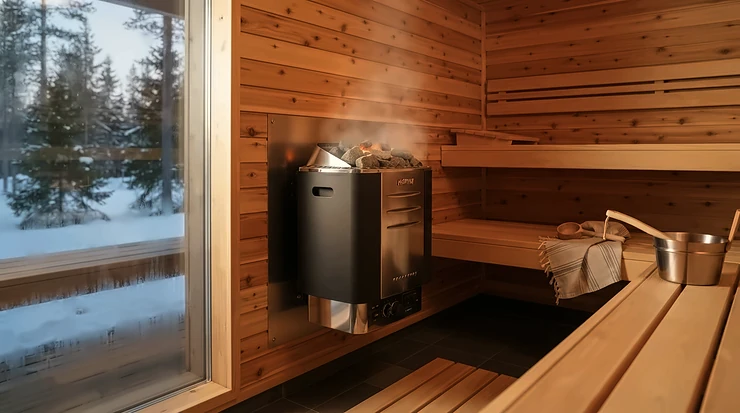
There’s a particular kind of regret that comes from buying the wrong sauna heater — the kind where you’re stood shivering in a “warm” room forty minutes after switching it on, wondering why your garden cabin feels like a slightly heated shed rather than a proper Finnish löyly experience. An electric sauna heater is the compact wall-mounted or floor-standing unit that heats sauna stones (and, indirectly, the air and your skin) using an electric element rather than burning wood, and it’s become the default choice for UK installations because it needs no flue, no firewood store, and no planning headache. Most residential properties in the UK run on a 240V single-phase power supply, and heaters up to roughly 9kW can typically run on that single-phase circuit, though it’s worth verifying compatibility case by case.
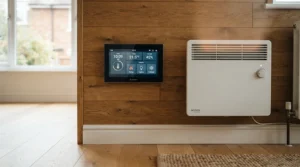
What most first-time buyers get wrong isn’t the brand — it’s the sizing and the safety wiring, two things Amazon listings barely touch on. This guide walks through seven genuinely good electric sauna heaters currently sold in the UK, spanning budget wall-mounted units through to premium app-controlled towers, alongside the kW-to-room-size maths, control unit compatibility, and the safety cut-off features that actually matter. There’s also a growing body of research suggesting regular sauna use carries real cardiovascular upside — a large Finnish cohort study found that long, hot sauna sessions were associated with fewer deaths from heart attacks, strokes, and related conditions — which is a nice bonus reason to get the heater choice right the first time.
Quick Comparison Table
| Product | Power Range | Best For |
|---|---|---|
| VEVOR 4.5kW Sauna Heater | 4.5kW | Budget builds, small cabins |
| Harvia KIP | 6–9kW | Reliable all-rounder, first-time builds |
| SAWO Scandia 9.0kW | 9.0kW | Mid-range with built-in control |
| Harvia Cilindro | 6.8–10.8kW | Steam-heavy löyly sessions |
| Harvia Spirit | 6.8–10.8kW | Design-forward glass-front saunas |
| HUUM DROP | 4.5–9kW | Smart app and WiFi control |
| EOS Invisio | 3.6–4.5kW | Space-saving under-bench install |
Looking at the spread above, there’s no single “best” electric sauna heater — the right pick genuinely hinges on your room’s cubic footage, how you like your heat (dry and sharp versus soft and steamy), and whether you want app control or a simple dial. Budget-focused builders will gravitate toward the VEVOR 4.5kW Sauna Heater or the workhorse Harvia KIP, while anyone chasing a smart-home-integrated sauna experience should look straight at the HUUM DROP. We’ll unpack exactly why in the sections below.
Found a heater that looks right for your space? A quick tap on the product name takes you to current availability and pricing.
Top 7 Electric Sauna Heaters: Expert Analysis
Choosing well here means matching kilowatts to cubic metres, not just picking the shiniest control panel. Below are seven real, currently available models spanning entry-level to premium, each with genuine spec interpretation rather than a repeated listing.
1. VEVOR 4.5kW Sauna Heater — best true budget entry point
The VEVOR 4.5kW Sauna Heater is the heater most people land on when they’re building their first small home sauna and don’t want to gamble a fortune on an unproven hobby. It runs on a 240V, 4.5kW capacity and is suitable for rooms between roughly 105 and 210 cubic feet, which in a typical UK garden cabin translates to a snug two-to-three-person space rather than a family-sized room.
Built from 304-grade stainless steel with mechanical knobs for temperature and timer adjustments, it favours simplicity over sophistication — there’s no app, no WiFi, just a dial you twist and forget about. Reviewers consistently note that for the price, the build quality punches well above expectations, though the mechanical timer lacks the precision of digital alternatives on pricier units.
It’s genuinely well suited to first-time sauna owners, renters converting a shed, or anyone testing whether they’ll actually use a home sauna before committing serious money.
Pros:
- ✅ Genuinely low entry cost for a first sauna build
- ✅ Durable 304 stainless steel resists corrosion long-term
- ✅ Simple mechanical controls with no learning curve
Cons:
- ❌ No app or remote control options
- ❌ Limited to smaller rooms under 210 cubic feet
Expect pricing in the low-to-mid hundreds range for the VEVOR 4.5kW Sauna Heater; at that price point it represents strong value for anyone building on a tight budget rather than chasing premium features.

2. Harvia KIP — the dependable workhorse everyone recommends
Ask any sauna installer which heater they’d fit without a second thought and the Harvia KIP comes up constantly. It’s a long-time favourite precisely because it’s straightforward, dependable, and proven across countless residential saunas, with a dual-wall stainless steel casing that stays cooler to the touch than single-wall alternatives — a genuinely useful detail if you’ve got kids or pets near the sauna. Controls come as built-in dial options on some variants, though many installers pair it with a separate control package for more precision. What the spec sheet won’t spell out is why professionals trust it: Harvia has decades of manufacturing history in Finland, and parts availability in the UK is genuinely excellent compared with smaller boutique brands. It’s best suited to small-to-medium saunas and first-time builds where reliability matters more than showpiece design.
Pros:
- ✅ Proven reliability across decades of installations
- ✅ Dual-wall casing stays cooler on the outside
- ✅ Excellent UK parts and service availability
Cons:
- ❌ Design feels utilitarian next to premium models
- ❌ Built-in dial control less precise than digital units
Priced in the mid-range bracket, the Harvia KIP offers arguably the best pound-for-pound reliability of any heater on this list — it’s the safe, sensible choice.
3. SAWO Scandia 9.0kW — mid-range power with a built-in control unit
The SAWO Scandia 9.0kW targets buyers who’ve outgrown entry-level units but don’t want the complexity (or cost) of a fully separate digital control package. It ships with a built-in control unit in the “NB” model, plus multi-voltage compatibility that suits different UK wiring setups. At 9.0kW, this sits right at the practical ceiling for single-phase domestic wiring, so it’s genuinely capable of heating larger cabins — think family-sized garden saunas rather than a solo two-person box — without needing a three-phase electrical upgrade. Reviewers who’ve compared it against smaller Scandia variants note the jump in heat-up speed is noticeable once you cross into rooms above roughly 300 cubic feet. It’s a sensible pick for anyone who wants “set it and forget it” simplicity but still needs serious output.
Pros:
- ✅ Built-in control unit avoids separate panel costs
- ✅ 9.0kW output suits larger family-sized cabins
- ✅ Multi-voltage flexibility for varied UK wiring
Cons:
- ❌ Sits at the top of single-phase capacity limits
- ❌ Bulkier housing than compact wall-mount rivals
The SAWO Scandia 9.0kW typically sits in the mid-to-upper price range, and it earns that position by genuinely saving you a separate control-panel purchase.
4. Harvia Cilindro — the steam specialist
If your idea of a proper sauna involves throwing water on the stones until the room fills with soft, enveloping steam, the Harvia Cilindro is built specifically for you. This tower heater is famous for its high stone capacity and its ability to create a soft, immersive sauna feel whenever water hits the rocks, and — importantly — it’s generally not designed to feel as dry-hot as heaters like the Spirit or Virta; it shines specifically when you use water on the stones, producing dense, satisfying steam rather than sharp dry heat.
That’s a genuinely useful distinction most buyers overlook: a heater optimised for steam and one optimised for dry heat are not interchangeable experiences, even at identical kW ratings.
The apertured stainless steel outer casing on the standard Cilindro allows for a large stone amount while the partially apertured Cilindro H variant suits smaller spaces, and the fully solid Cilindro F casing produces a sharper bath than the softer alternatives.
Pros:
- ✅ Exceptional steam production from high stone capacity
- ✅ Variant options (standard, H, F) suit different room sizes
- ✅ Tower design distributes heat more evenly floor-to-ceiling
Cons:
- ❌ Takes up more floor space than wall-mounted units
- ❌ Premium pricing versus comparable wall-mount models
Expect the Harvia Cilindro to command a premium price versus wall-mounted rivals, which is justified if steam quality is genuinely your priority.
5. Harvia Spirit — the design-forward glass-front choice
The Harvia Spirit is aimed squarely at buyers who want their sauna to look as good as it performs — think glass-fronted cabins where the heater itself is on display rather than tucked in a corner. It’s a modern wall-mounted design capable of strong heat output while still delivering a comfortable feel when you add water to the stones, and it’s compatible with modern digital control packages, which matters if you’re already running smart-home automation elsewhere in the property. What most buyers overlook about this model is that its slim wall-mounted profile actually frees up meaningful bench space in smaller cabins, something a bulky floor-standing tower simply can’t match. It’s the heater you choose when the sauna is a design statement as much as a wellness routine.
Pros:
- ✅ Sleek wall-mounted profile saves valuable floor space
- ✅ Strong heat output paired with comfortable steam
- ✅ Compatible with modern digital control systems
Cons:
- ❌ Higher cost reflects the design premium
- ❌ Wall-mount position limits stone capacity versus towers
The Harvia Spirit sits firmly in the premium bracket — a fair trade if a design-forward, glass-front install is the goal.

6. HUUM DROP — best for smart app and WiFi control
For anyone who wants to start their sauna heating up from the sofa before they’ve even changed into a towel, the HUUM DROP is the standout. It’s a wall-mounted heater offering two remote control routes — WiFi connectivity through the HUUM mobile app, letting you set start and end times plus your ideal temperature and get a notification once the sauna’s ready, or the included portable UKU WiFi controller for adjusting settings from inside the sauna itself without getting up. Connectivity extends to lighting and ventilation too, so both can be managed from the same app or controller.
It comes in four sizes — 4.5kW, 6kW, 7.5kW, and 9kW — covering sauna sizes between roughly 110 and 530 cubic feet, and holds up to 132 pounds of sauna stones for consistent heat retention.
One practical tip worth flagging from independent testing: mounting the temperature sensor too close to the ceiling in a tall sauna causes it to read hot air prematurely and shut the heater down before bench level actually reaches a usable temperature — sensor placement nearer bench height avoids this entirely.
Pros:
- ✅ Full app control including start times and notifications
- ✅ Four size options cover small to large sauna rooms
- ✅ Red Dot Design Award-winning build quality
Cons:
- ❌ Sensor placement needs care to avoid premature shut-off
- ❌ Some reported heating element issues under heavy weekly use
Priced at the premium end, the HUUM DROP justifies its cost for anyone who genuinely values app-based scheduling and remote control over a manual dial.
7. EOS Invisio — the lesser-known space-saving alternative
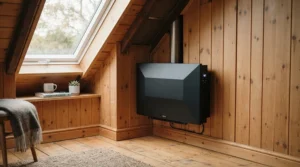
Most buyers researching electric sauna heaters never stumble across the EOS Invisio, which is a shame because it solves a genuinely specific problem: tiny saunas where wall space is precious. It’s an under-bench model designed to tuck away and free up wall space entirely, running at 3.6–4.5kW with a rock capacity of roughly 30–50 pounds — modest compared with tower heaters, but entirely sufficient for a compact one-or-two-person cabin. EOS as a manufacturer covers an unusually wide range, from this compact under-bench model right up to massive commercial units, which speaks to genuine engineering depth rather than a single lucky product. If you’re squeezing a sauna into a box room, loft conversion, or narrow garden pod where every centimetre of wall counts, this is the one heater on this list built specifically for that constraint.
Pros:
- ✅ Under-bench design frees up all wall space
- ✅ Compact footprint suits tight or awkward rooms
- ✅ Backed by EOS’s broad manufacturing pedigree
Cons:
- ❌ Lower stone capacity limits steam intensity
- ❌ Harder to source and service in the UK than Harvia
Pricing sits in the mid-range bracket for the EOS Invisio, representing solid value specifically for space-constrained builds where no other model on this list would physically fit.
Practical Usage Guide: Setup, First 30 Days, and Maintenance
Getting your new heater installed is only step one. In the first 30 days, resist the urge to run it at maximum output on day one — most manufacturers recommend a gentler “burn-in” session or two at moderate heat to cure the stones and let the element settle, particularly with heaters like the Harvia Cilindro or SAWO Scandia 9.0kW that carry a large stone mass. Check the stone bed after the first few sessions; stones settle and shift as they heat and cool, and a top-up after the first month is completely normal, not a fault.
For ongoing maintenance, inspect the stones every three to six months for cracking — a cracked stone loses its heat-retention properties and can eventually block airflow through the element housing, especially in tower designs like the Harvia Cilindro. Wipe down the exterior casing monthly with a damp cloth; stainless steel models like the VEVOR 4.5kW Sauna Heater resist corrosion well but still benefit from having mineral deposits from splashed water removed regularly. The single most common first-month mistake is leaving the door open during heat-up, which fights the thermostat and can trip safety cut-offs unnecessarily on units like the HUUM DROP — keep it closed and let the sensor do its job.
Real-World Scenario: Which Heater Fits Your Situation
Picture Sarah, a first-time sauna owner converting a garden shed in Bristol into a compact two-person retreat. Budget-conscious and using it perhaps twice a week, the VEVOR 4.5kW Sauna Heater or Harvia KIP both fit her modest 150-cubic-foot space without overspending on capacity she’ll never use.
Now consider the Whitfield family, who’ve built a proper 350-cubic-foot cedar cabin for regular use across four people. Here the SAWO Scandia 9.0kW or HUUM DROP at its 9kW setting make far more sense — enough headroom to heat the larger volume quickly even on cold February evenings, with the DROP’s app scheduling meaning it’s ready the moment everyone’s home from work.
Finally, think of Priya, renovating a loft-adjacent box room where floor space is at an absolute premium and daily steam-heavy sessions matter more than raw size. The EOS Invisio tucked under the bench, or the Harvia Cilindro if she can spare the floor footprint, both deliver the steam experience without dominating a tiny room.
How to Choose an Electric Sauna Heater
- Measure your room’s cubic footage first. Every other decision flows from this number — guessing leads to under-heating or wildly oversized units.
- Decide dry heat versus steam-heavy. Models like the Harvia Cilindro favour steam; wall-mounted units like the Harvia Spirit trend drier.
- Confirm your electrical supply. Most UK homes handle up to roughly 9kW on single-phase; anything above needs specialist wiring.
- Choose your control preference. Simple dials suit the VEVOR 4.5kW Sauna Heater; app control suits the HUUM DROP.
- Check stone capacity against your steam expectations. Higher capacity retains heat longer between water throws.
- Factor in installation space. Wall-mounted, floor-standing, and under-bench models each solve different room shapes.
- Budget for professional wiring, not just the heater. This is consistently the line item first-time buyers forget.
kW Rating for Room Size: Getting the Sizing Right
This is the single most-botched decision in home sauna buying. As a rough rule of thumb, expect roughly 1kW per 45-50 cubic feet of sauna volume under normal insulation conditions — so a compact 150-cubic-foot cabin suits a 3-4.5kW unit like the VEVOR 4.5kW Sauna Heater or EOS Invisio, while a 300-350-cubic-foot family cabin genuinely needs the 9kW ceiling offered by the SAWO Scandia 9.0kW or the top-spec HUUM DROP. Undersizing is the more common mistake — buyers assume a smaller heater saves money, then spend 45 minutes waiting for a room that should heat in 20. Oversizing wastes energy and can make the room uncomfortably fierce near the heater while corners lag behind. Poor insulation, glass walls, and high ceilings all push you toward the higher end of the range regardless of floor area.
Control Unit Compatibility: What Actually Matters
Not every control panel works with every heater, and this trips up more buyers than you’d expect. Electric sauna heaters generally offer built-in, external, or smart WiFi control options, and matching the right one to your setup is worth getting right before you buy rather than after. Built-in mechanical controls, as found on the VEVOR 4.5kW Sauna Heater, are the simplest and cheapest but offer no remote scheduling. External digital control packages — the route many installers pair with the Harvia KIP or Harvia Spirit — add programmable timers and more precise temperature holding, at extra cost and complexity. Smart WiFi systems, exemplified by the HUUM DROP‘s app and UKU controller combination, add genuine convenience but introduce another thing that can fail or need a firmware update. Before buying, always check the manufacturer’s compatible control unit list — heaters and control panels aren’t universally interchangeable across brands, and a mismatched pairing is a genuinely avoidable expense.
Safety Cut-Off Features and UK Regulations
Safety cut-off features aren’t optional extras — they’re the difference between a relaxing sauna and a house fire. Look for a heater with built-in thermostatic control, a safety cut-out, and an on/off timer, which together prevent the unit being left running unattended. Beyond the heater itself, UK building regulations treat this seriously: electrical work in a sauna is explicitly classed as notifiable under Building Regulations Part P, the same category as bathrooms and kitchens, meaning it must be installed or certified by a competent registered electrician rather than done casually as DIY. Internationally, the governing product safety standard for these appliances is BS EN 60335-2-53, which covers electric sauna heaters and infrared units up to 20kW and sets the safety benchmarks any UK-sold heater should meet. Practically, always keep the safety guard rail in place around stones (fitted on models like the Harvia KIP and SAWO Scandia 9.0kW), maintain the manufacturer’s minimum clearance to combustible surfaces, and never bypass a tripped thermal cut-out without identifying the cause first.
Electric Sauna Heater vs Wood-Burning Stove
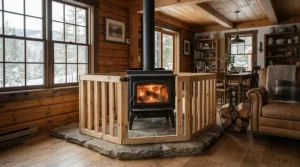
Neither type is inherently better — they serve genuinely different needs. Electric heaters offer convenience, precise control, and minimal maintenance, making them well suited to daily wellness routines and indoor installations, while wood-burning stoves deliver the most authentic traditional experience, tend to suit social sessions better, and can carry lower running costs if you have access to affordable firewood. For UK homeowners specifically, electric models like the Harvia KIP or HUUM DROP win on convenience — flick a switch, walk away, come back to a ready sauna without managing a fire or storing logs. Wood-burning wins on atmosphere and, in rural properties with free or cheap timber, running cost. One planning nuance worth knowing: wood-burning installations can face additional scrutiny in conservation areas or smoke control zones, whereas electric installations generally don’t carry that same planning friction. For most suburban and urban UK gardens, electric remains the pragmatic default.
Common Mistakes When Buying an Electric Sauna Heater
The most expensive mistake is buying on kW alone without checking room volume — a heater that’s technically “powerful enough” on paper can still underperform in a poorly insulated cabin. Second is ignoring control unit compatibility, discovering only after delivery that your chosen external panel doesn’t pair with your chosen heater. Third is skipping professional electrical certification to save money upfront — a decision that can complicate a future house sale and, far more importantly, creates genuine fire risk. Fourth is underestimating stone quality and quantity, particularly with steam-focused units like the Harvia Cilindro, where a sparse stone bed undermines the entire point of the design. Finally, many buyers forget to budget for the control panel and wiring separately from the heater’s own price, then find the “bargain” unit costs considerably more once properly installed.
Long-Term Cost and Maintenance
Running costs vary meaningfully by usage pattern rather than heater brand. A 6kW heater like the mid-tier Harvia KIP used for three 45-minute sessions weekly draws considerably less over a year than a 9kW SAWO Scandia 9.0kW run daily, so total cost of ownership depends heavily on your household’s actual habits rather than the sticker price alone. Stone replacement every two to three years, occasional element replacement on heavily used units — independent testers have reported heating element and timer failures within the first year on some models used two to three times weekly, a pattern worth budgeting against regardless of brand — and periodic professional inspection all factor into genuine long-term value. Cheaper units like the VEVOR 4.5kW Sauna Heater win on upfront cost but may need element replacement sooner under heavy use; premium builds like the Harvia Spirit typically justify their price with longer component lifespans.
Frequently Asked Questions
❓ What size electric sauna heater do I need for a small home sauna?
❓ Can I install an electric sauna heater myself in the UK?
❓ How long does an electric sauna heater take to heat up?
❓ Do electric sauna heaters need a special electrical circuit?
❓ Is an electric sauna heater cheaper to run than a wood-burning one?
Conclusion
Picking the right electric sauna heater really comes down to three honest questions: how big is your room, how do you like your heat, and how hands-on do you want the controls to be. Budget builders can’t go wrong with the VEVOR 4.5kW Sauna Heater or the dependable Harvia KIP; anyone chasing serious steam should look at the Harvia Cilindro; design-conscious glass-front installs suit the Harvia Spirit; larger family cabins want the headroom of the SAWO Scandia 9.0kW; smart-home enthusiasts should go straight for the HUUM DROP; and anyone fighting for wall space will appreciate the EOS Invisio. Whichever you choose, get the electrical work certified properly through a registered competent person rather than cutting corners — it’s the one part of this purchase that genuinely isn’t worth DIY-ing.
Recommended for You
- Traditional Sauna vs Infrared Sauna: 7 Best Buys For UK (2026)
- Traditional Saunas Under £2000: 7 Best UK Picks (2026)
- Traditional Sauna for Home: 7 Best Picks for UK Gardens (2026)
Disclaimer: This article contains affiliate links. As an Amazon Associate, I earn from qualifying purchases. If you purchase products through these links, we may earn a small commission at no additional cost to you.
✨ Found this helpful? Share it with your friends! 💬🤗
